Website, PWA, or Native App: The Real Cost Over 12 Months for Your Business
Decide between a website, PWA, or native app. Discover the real cost over 12 months and the best option for your SMB, retailer, or startup.

Website, PWA, or Native App: The Real Cost Over 12 Months
The choice between a responsive website, a Progressive Web App (PWA), or a native application for your business is one of the most crucial decisions when launching a digital product. Often, the technical discussion dominates, but the reality is that the determining factor for Small and Medium-sized Business (SMB) owners, retailers, and startup founders is the total cost involved, especially in the first year of operation. This comprehensive guide will demystify the expenses associated with each option, focusing on concrete figures and timelines so you can make the most informed decision for your business.
The top search results for "responsive website or app what is better for my company" are usually filled by agencies listing pros and cons, but rarely detailing the real financial impact on your wallet over a significant period like 12 months. Let's analyze the complete scenario, considering not just initial development but also annual maintenance, store fees, and the time until you start generating value with your customer.
Key Points
- Total Cost Over 12 Months: The decision should be based on the total investment, including development, maintenance, and fees, not just the initial cost.
- Development vs. Maintenance: Native apps have a higher development cost, but maintenance can be proportionally higher than that of PWAs.
- Timelines Matter: The time it takes to get your product live directly impacts return on investment (ROI) and customer acquisition.
- Store Fees: Apple and Google charge commissions on transactions, a cost to consider for transactional apps.
- Specific Features: The need for hardware access (Bluetooth, NFC) or advanced features (ARKit) may steer the choice towards native apps.
The Basics: Responsive Website
A responsive website is the digital foundation for most businesses. It adapts to different screen sizes – desktops, tablets, and smartphones – ensuring a good browsing experience on any device. In terms of cost, it is generally the most accessible option for initial development.
Development: The cost of a responsive website varies enormously depending on complexity, features, and the development team hired. For a simple institutional or catalog website, costs can range from R$ 5,000 to R$ 30,000. More complex websites, with integrations and advanced functionalities, can exceed R$ 50,000.
Annual Maintenance: Maintaining a responsive website is usually more predictable and affordable. It generally involves content updates, security, bug fixes, and optimizations. Estimates point to an annual cost between 10% to 20% of the initial investment.
Advantages: Immediate global accessibility (anyone with a browser can access it), robust SEO, lower initial cost, and simpler maintenance.
Disadvantages: Limited offline engagement capabilities, restricted access to the device's hardware resources.
The Intermediate: Progressive Web App (PWA)
A Progressive Web App (PWA) is a type of web application that offers an experience similar to a native app but is accessed through a browser. It can be installed on the device's home screen, function offline (with limited features), and send push notifications. PWAs aim to combine the best of both worlds: the accessibility of the web with the app experience.
Development Costs and Timelines
Figures compiled by Agencia Ape (2026) indicate that PWA development costs between R$ 15,000 to R$ 80,000, with a delivery timeline of 1 to 4 months. This cost range is due to the flexibility of web technologies and the ability to focus on essential features.
Maintenance and Fees
Annual PWA maintenance is estimated between 10% to 15% of the initial cost, according to Agencia Ape (2026). A crucial point is that PWAs do not go through traditional app stores (Apple App Store and Google Play Store) for direct distribution, meaning you avoid the 15% to 30% commission fees on in-app transactions that apply to native apps. However, it is important to note that distribution and discovery may depend more on digital marketing and SEO strategies.
PWA Limitations
Despite its many advantages, PWAs have limitations. Push notifications on iOS, although available since iOS 16.4, may still present restrictions compared to native apps. Furthermore, PWAs generally do not have direct access to hardware resources like Bluetooth, NFC, and more advanced technologies like ARKit.
The Advanced: Native App
A native app is developed specifically for an operating system (iOS or Android) and installed directly on the user's device. They offer the best performance, full access to hardware resources, and the most fluid and integrated user experience.
Development Costs and Timelines:
The costs to develop a native app are significantly higher. Agencia Ape (2026) estimates that a native app for iOS and Android can cost from R$ 80,000 to over R$ 500,000, with a development timeline ranging from 4 to 12 months. This variation depends on complexity, number of features, and whether development is done separately for each platform.
An alternative is the hybrid app, which uses frameworks like React Native or Flutter. This approach allows for a single codebase for both platforms, reducing costs and timelines. According to Agencia Ape (2026), a hybrid app costs between R$ 50,000 to R$ 300,000, with timelines of 3 to 8 months.
Cost Breakdown with Mind Group
Mind Group (2026) details price ranges by complexity in the Brazilian market in 2026:
- Showcase or Catalog App: R$ 35,000 to R$ 80,000, with a timeline of 6 to 10 weeks.
- App with Registration and Intermediate Features: R$ 90,000 to R$ 250,000, in 3 to 5 months.
- Transactional App or Marketplace: R$ 280,000 to R$ 700,000, in 5 to 9 months.
Add-ons and Recurring Costs
In addition to base development, additional features can scale the cost:
- Integrated payment: plus R$ 25,000 to R$ 80,000.
- Admin panel: plus R$ 50,000 to R$ 200,000.
- AI or recommendation engine: plus R$ 40,000 to R$ 150,000 (plus recurring inference costs).
Annual Maintenance and Store Fees
Annual maintenance for a native app, according to Agencia Ape (2026), can range from 20% to 30% of the initial cost. Mind Group (2026) suggests a range of 18% to 30%, meaning a R$ 200,000 app could require R$ 36,000 to R$ 60,000 per year in maintenance. Also remember store licenses: Apple Developer at USD 99 per year and Google Play account at USD 25 (one-time payment).
Store Fees: Apple and Google charge 15% to 30% on transactions made within the app, a cost that directly impacts the profitability of transactional apps.
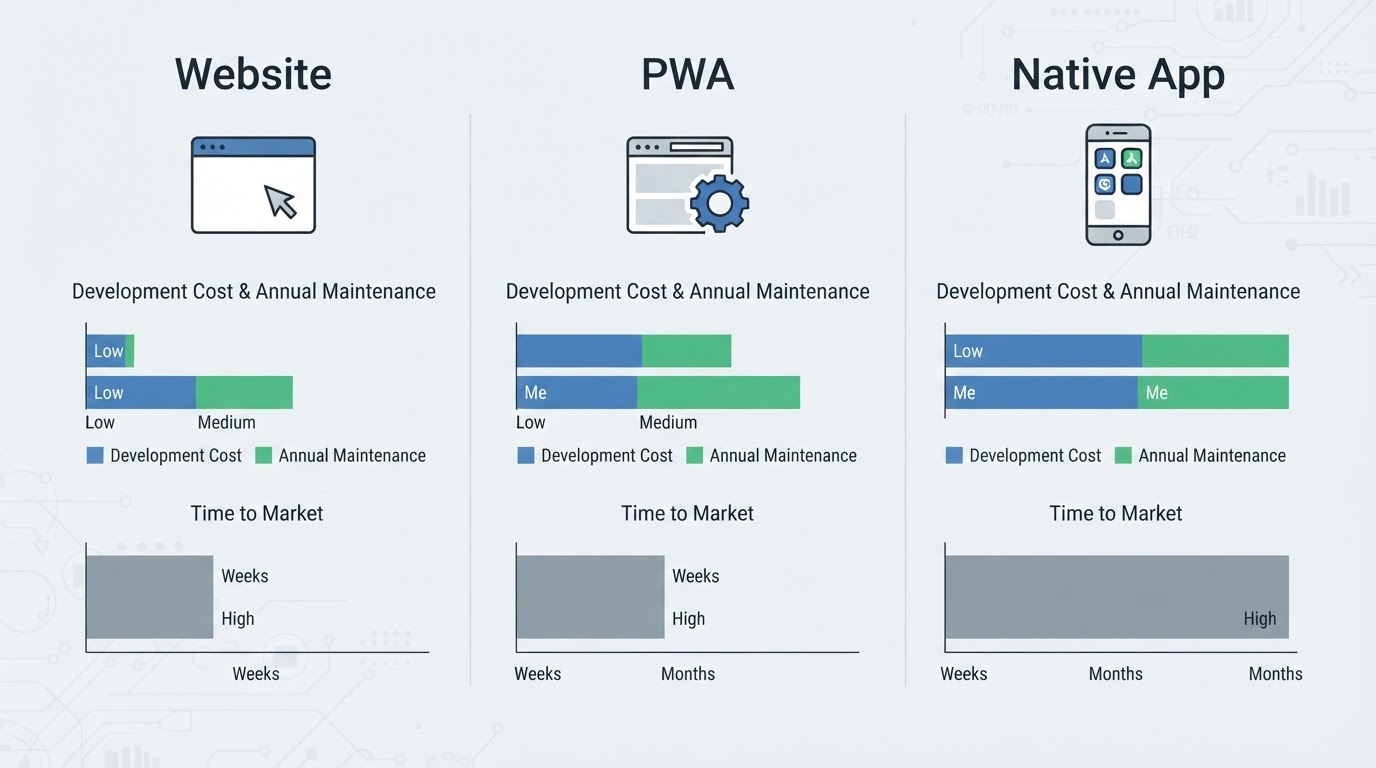
Cost and Timeline Comparison Over 12 Months
To make an informed decision, it is essential to visualize the total investment over a 12-month period. Let's consider an average development scenario for an app with registration and intermediate features.
| Feature | Responsive Website (Average) | PWA (Average) | Hybrid App (Average) | Native App (Average) |
|---|---|---|---|---|
| Initial Cost | R$ 15,000 | R$ 45,000 | R$ 150,000 | R$ 290,000 |
| Delivery Timeline | 1-2 months | 2-3 months | 4-6 months | 7-9 months |
| Annual Maintenance | R$ 3,000 (20%) | R$ 6,750 (15%) | R$ 22,500 (15%) | R$ 72,500 (25%) |
| Store Fees (Estimated) | N/A | N/A | 15-30% (if applicable) | 15-30% (if applicable) |
| Total Annual Cost (Estimated) | R$ 18,000 | R$ 51,750 | R$ 172,500 + Fees | R$ 362,500 + Fees |
Note: Annual maintenance values for PWA and Hybrid App were calculated based on 15% of the initial cost, and for Native App at 25%. Store fees are only applicable to direct transactions within the app and were not included in the total for simplification, but should be rigorously considered for transactional apps.
The choice between platforms is not just about what you want to build, but about what your business can financially and strategically sustain in the medium and long term.
What is the Best Option for Your Business?
The answer fundamentally depends on your business model, target audience, and budget.
For Startups and SMBs with Limited Budgets:
A responsive website is the ideal starting point. It allows you to have a professional online presence, optimized for SEO and accessible to everyone, with a low initial investment. As the business grows, you can evolve to a PWA. A PWA is an excellent choice for companies seeking greater engagement, push notifications, and the ability to function offline, without the high cost of a native app. Retailers who want to offer a smoother shopping experience, but still within a controlled budget, can greatly benefit from a PWA.
For Businesses Requiring High Performance and Integration:
If your business relies on advanced features, such as precise real-time geolocation, integration with specific phone hardware (like biometric sensors, Bluetooth for IoT devices, NFC for contactless payments), or a flawless user experience with high graphical performance, a native app is the choice. Games, video/image editing applications, or apps requiring intensive processing benefit from this approach. Transactional apps or marketplaces with high usage frequency and the need for integrated payment flows may justify the investment in a native app, remembering store fees and ongoing maintenance.
Frequently Asked Questions
Can a PWA completely replace a native app?
For most SMBs and retailers, a PWA can offer a quite complete experience, covering essential features like purchases, content access, and notifications. However, if your application needs deep access to specific device hardware (like ARKit for augmented reality, or more complex hardware APIs) or if the user experience absolutely needs to be the most optimized possible in every performance detail, a native app still has an advantage.
What are the maintenance costs of a PWA compared to a native app?
In general, PWA maintenance is cheaper. According to Agencia Ape (2026), PWAs cost between 10% to 15% of the initial value per year in maintenance, while native apps can cost from 20% to 30%. This is because PWAs are built with web technologies, which generally have more stable and accessible update cycles and development ecosystems.
Should I worry about app store fees?
If you opt for a native app (or even a PWA distributed via stores like Google Play), store fees are an important consideration, especially for transactional apps. Apple and Google charge 15% to 30% on sales or transactions within the app. If your business model relies on many small transactions, these fees can significantly erode your profit margin. PWAs distributed directly via the web avoid these fees.
What is the timeline to get a first customer using my solution?
The timeline is a critical factor for return on investment. A responsive website can be ready in 1 to 2 months. A PWA, in 1 to 4 months. A hybrid app can take 3 to 8 months, and a full native app, 4 to 12 months. The speed at which you can launch and start validating your product in the market is a competitive advantage.
Conclusion
The decision between a website, PWA, or native application should be guided by a careful analysis of the total cost over 12 months, including development, maintenance, fees, and the time to reach the first customer. PWAs offer an excellent balance of cost, functionality, and user experience for most SMBs and retailers. Native apps are for use cases that require maximum performance and deep hardware access.
Recommendation: Start by validating your idea with a robust responsive website or a PWA. Analyze usage data and customer feedback to justify the investment in a native app, if necessary. Gradually increase complexity and investment, aligned with your business growth.

About Lee Sugano
Lee Sugano
Digital solutions agency based in Japan, serving clients in 10+ countries. We share insights on development, design and digital marketing for companies that don't settle for generic.
Enjoyed this content?
Receive exclusive insights about web development, design, and digital marketing straight to your inbox.
No spam. Unsubscribe anytime.