Does the runoff voting extension void the election? Law, logs and deadlines
34,330 votes were recorded after 5 p.m., but the margin exceeds 4.3 million. Understand the criticisms, the defenses and the calendar up to the inauguration.

Under the law, the extension of voting in the runoff can support requests for annulment, but it is unlikely to void the election. The Electoral Code requires demonstrated harm to declare a nullity and only orders a new election if the annulled votes exceed half. The public voting machine logs record 34,330 votes after 5 p.m., against a margin of 4,430,191 votes between the candidates.
On Sunday, October 25, 2026, voting in the presidential runoff was extended until 7 p.m. by decision of an STF justice, after an afternoon of competing requests from both campaigns. The measure opened a legitimate debate about who has authority to change voting hours and fueled talk of annulment.
This post brings together the complete timeline, what each article of law cited in the debate says, how to check the log for your own polling section, and what can still happen before the inauguration. Criticisms and defenses appear side by side, without cheerleading.
Key points
- The extension until 7 p.m. was decided by Cristiano Zanin, of the STF, and later limited to sections whose voting machines had not yet been closed.
- The logs show 34,330 votes after 5 p.m.: 29,001 from people who were in line until 5:05 p.m. and 5,329 after that.
- Even discounting all of these votes, the margin between Lula and Flávio Bolsonaro remains above 4.3 million.
- The discussion about the TSE's authority is legitimate; the numerical effect of the extension is small.
- Certification by 12/18, a 15-day deadline to challenge the mandate, and inauguration on 1/5/2027.
Timeline: how voting in the runoff was extended
All times below are Brasília time, on Sunday 10/25/2026.
- 1:22 p.m.: Lula's campaign asks the TSE for more voting time due to a lack of buses in Bahia. Procon-BA found 544 buses parked in garages.
- 3:42 p.m.: Lula's campaign request is expanded to cover all states.
- 3:50 p.m.: Flávio Bolsonaro's campaign asks for more time in 19 cities in São Paulo, Paraná and Santa Catarina, citing rain, flooding and power outages.
- 4:22 p.m.: with no decision from the TSE, Lula's campaign turns to the STF.
- 5:03 p.m.: Zanin, in Complaint 101,673, extends voting until 7 p.m. nationwide.
- 5:06 p.m.: the TSE suspends the release of the vote count, resumed at 7 p.m.
- About an hour later: Zanin clarifies that the extension applies only where the voting machine had not been closed.
The starting point, therefore, was a concrete transportation problem in one state, which then became a nationwide request and ended up also prompting a request from the opposing campaign.
The legal basis used by Zanin
The decision that extended runoff voting until 7 p.m. relied on a 2023 order from the STF itself, ADPF 1013. An ADPF (claim of noncompliance with a fundamental precept) is a type of action used to protect rights set out in the Constitution; in this case, the STF ordered the government to provide free public transportation on election day. The reasoning of the Complaint was: if the 2023 order was not complied with, affected voters would need more time.
The disagreement within the Judiciary
On the other side, the president of the TSE, Nunes Marques, stated that no rule authorized the extension. It is this disagreement between an STF justice and the head of the Electoral Court that underpins much of the criticism made since then.
What the law says about voting extensions and annulment
Six provisions appear in almost every discussion. The first five are in the consolidated text of the Electoral Code on the Planalto website, and the last one is in the Constitution.
| Provision | What it establishes | Weight in the debate |
|---|---|---|
| Electoral Code, art. 144 | Voting runs until 5 p.m. | Basis for the argument that the schedule was violated |
| Electoral Code, art. 153 | Anyone in line at 5 p.m. receives a ticket and votes | Explains why there are always votes after 5 p.m. |
| Electoral Code, art. 220, III | Voting held at a time other than the designated one is null | Main support for those seeking annulment |
| Electoral Code, art. 219 | No nullity is declared without demonstrated harm | Filter against automatic annulments |
| Electoral Code, art. 224 | A new election only if the nullity exceeds half of the votes | Defines when the entire election falls |
| Constitution, art. 14 | Every vote has equal value | Used by both sides: equal access and equal rules |
Art. 220, III, is the strongest argument for those contesting the result: the law expressly mentions nullity due to a different time. But it does not work alone. Art. 219 requires someone to demonstrate concrete harm, and art. 224 sets the bar for a new election.
Annulling votes and annulling the election are different things. Even if votes after 5 p.m. were deemed null, the election would only be rerun if the nullity affected more than half of the votes.
The numbers in the logs: how much the extension weighed on the result
The official result was Lula with 64,256,232 votes (51.79%) and Flávio Bolsonaro with 59,826,041 (48.21%), a margin of 4,430,191 votes.
According to TSE data on voting after the extension, the public voting machine logs record 34,330 votes after 5 p.m. Of these, 29,001 were cast by 5:05 p.m., which is consistent with voters who were already in line and had received a ticket. The other 5,329 came later, and the last vote was recorded at 7:06 p.m. For comparison, in the 1st round the votes recorded after 5 p.m. totaled 3,724,999.
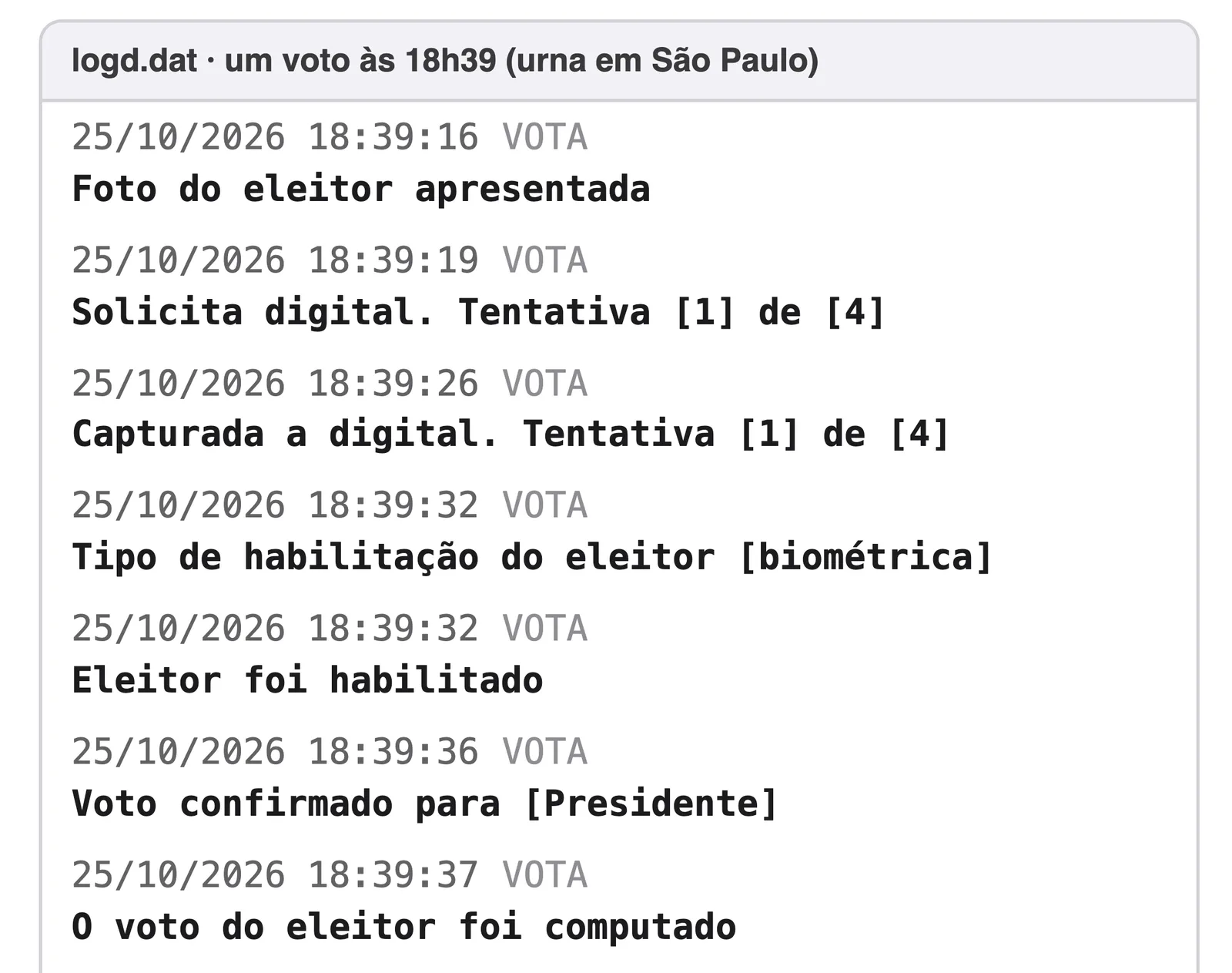
There is a decisive technical detail: the machine's log, which is the device's event journal, records the time of each step of the voting process, but never the candidate chosen. The vote itself is stored in a separate file, with no timestamp. That is why it is impossible to know whom the people who voted after 5 p.m. voted for.

Since there is no way to know where these votes went, the conservative calculation is to assume the worst-case scenario for the winner: all 34,330 went to Lula. Removing all of them, the margin would drop to 4,395,861 votes, still above 4.3 million. Votes cast after 5 p.m. represent less than 0.03% of the votes for the two candidates.
How to check your polling section's log
Anyone can access the files for each polling section on the TSE Results website. The general steps are:
- Go to the TSE Results website and select the 2026 2nd round election.
- Find your section by state, municipality, electoral zone and section number (this information is on your voter ID card).
- Download the files available for that section.
- Open the log file and look for vote records timestamped after 5 p.m.
- Compare the time of the last vote with the closing time reported for the section.
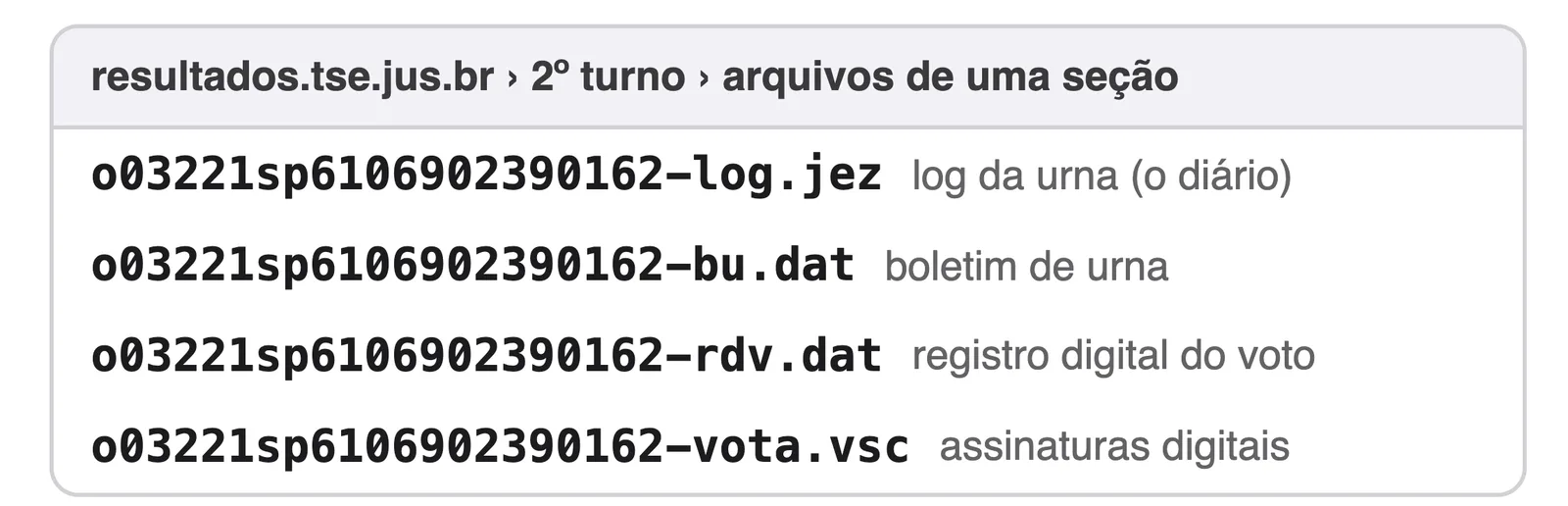
Each section has four public files: the log, the voting machine bulletin (the vote summary printed at the end of voting), the digital vote record, known as RDV, which stores votes without timestamps, and the digital signatures that guarantee the files have not been altered.
For those who want to go beyond their own section, there are open source initiatives that work with this data in bulk, such as the logsdasurnas repository on GitHub. That is precisely the advantage of public data: no one has to rely solely on one side's word.
Criticisms and defenses side by side
What critics say
- Jurisdiction: setting voting hours is the TSE's responsibility, not the STF's.
- Impartiality: Zanin was Lula's lawyer before joining the Supreme Court.
- Legal basis: the TSE president stated that no rule authorized the extension, and art. 220, III, provides for nullity when voting occurs at a different time.
- Institutional reaction: there is an impeachment request against Zanin, still awaiting a Senate decision.
What defenders say
- Grounds: the decision relied on ADPF 1013, a 2023 STF order on free public transportation on election day, and on the bus shortage confirmed by Procon-BA.
- Requests from both sides: Flávio's campaign also asked for more time, in 19 cities in the South and Southeast.
- Limited scope: a clarification restricted the measure to machines that had not yet closed.
- Effect: under arts. 219 and 224, with no demonstrated harm and far from half of the votes, there is no basis for a new election.
The debate over who can change voting hours is legitimate and should continue. What the numbers do not support is the idea that the extension changed the winner.
What can still happen before the inauguration
On 10/26, Flávio Bolsonaro backed away from the annulment argument and said he will seek the removal of the ticket, meaning loss of office by a decision of the Electoral Court, a different path from annulling votes.
Abroad, Donald Trump questioned the election without presenting evidence. The U.S. has not officially recognized the result, but an internal U.S. embassy report, according to Folha, called the victory definitive.
The calendar that matters from here on:
- By 12/18: certification of the winners, the act that makes the result official.
- 15 days: deadline to challenge the mandate in court.
- 1/5/2027: inauguration.

Frequently asked questions
Can extending voting hours in the runoff void the election?
In practice, it is very unlikely. Article 220, III, of the Electoral Code provides for voiding votes cast at a different time, but Article 219 requires demonstrated harm, and Article 224 only calls for a new election if the voided votes exceed half of the total. Votes cast after 5 p.m. add up to 34,330.
How many votes were cast after 5 p.m. in the 2026 runoff?
The public logs record 34,330 votes after 5 p.m. Of those, 29,001 were cast by 5:05 p.m. by voters already in line, and 5,329 after that, with the last one at 7:06 p.m.
Does the voting machine log show who a person voted for?
No. The log only records the time of each step of the voting process. The vote itself is stored in the digital vote record, a separate file with no timestamps, which preserves ballot secrecy.
Who rules on a request to void the election or remove the ticket?
The Electoral Court. After the certification of the winners, which must take place by December 18, a 15-day window opens to challenge the mandate.
When will the president elected in 2026 take office?
The inauguration is scheduled for January 5, 2027.
Conclusion
The runoff extension raises a serious question of jurisdiction, and both critics and defenders have real legal arguments. But according to the law itself and the numbers in the logs, the effect is far too small to change the outcome: even discounting every vote cast after 5 p.m., the margin remains above 4.3 million.
Practical recommendation: visit the TSE Resultados website today, download the log for your polling station, and see for yourself what time the last vote was recorded.

About Lee Sugano
Lee Sugano
Digital solutions agency based in Japan, serving clients in 10+ countries. We share insights on development, design and digital marketing for companies that don't settle for generic.
Enjoyed this content?
Receive exclusive insights about web development, design, and digital marketing straight to your inbox.
No spam. Unsubscribe anytime.