AI Reverse Engineering: How to Use REA Within the Law
REA connects agents like Claude Code and Cursor to tools that analyze binaries, APKs, and websites. See what it really does and where the legal line is.
What REA's AI reverse engineering is
AI reverse engineering is what REA (Reverse Engineer Anything) does: it connects your coding agent to analysis tools to figure out how an app works on the inside, even without the source code. The project is open source, lives on GitHub under the MIT license, and passed 380,000 stars in a little over six months.
The promise is real, but it has context. REA is not a magic button that copies software: it collects evidence (code snippets, references, and points that are not yet understood) and hands it to the AI agent, which explains, implements, and tests. The project itself also prohibits several uses, and Brazilian law has clear rules about what is allowed.
In this guide you will learn what the tool does, how to install it, what it analyzes, what Brazil's Software Law says, and how to apply this to your business without getting into trouble.
Key takeaways
- REA is an MCP server that connects agents like Claude Code, Codex, Cursor, and Gemini CLI to analysis tools.
- Installation is a single npm command and requires Node.js 22 or newer.
- It analyzes native binaries, JavaScript and Electron apps, .NET, Android APKs, websites, and firmware.
- The project's DISCLAIMER prohibits bypassing DRM, licensing, and anticheat or copying proprietary software.
- In Brazil, Law 9.609/1998 allows functional similarity and essential integration for personal use, but punishes copyright infringement.
REA by the numbers: why the project exploded
The REA repository on GitHub was created on 04/14/2026 and is published under the MIT license, a permissive license that allows using, modifying, and redistributing the code. The official description sums up the idea: reverse engineer anything with AI agents, from app behavior down to the native binary.
The growth is striking. On 10/12 the project had about 130,000 stars; by 10/26/2026 it had 384,512 stars and 96,234 forks. The latest version is rea-agents 6.8.0, from 10/25/2026, distributed via npm.
This interest follows a trend we already covered in the list of apps AI can already rebuild: when agents can understand software from the outside, rebuilding features gets much cheaper.
How AI reverse engineering works in REA
REA is an MCP server. MCP (Model Context Protocol) is a standard that lets an AI agent call external tools in an organized way. In practice, REA becomes a toolbox your coding agent starts using: Claude Code, Codex, Cursor, Gemini CLI, Grok Build, and others.
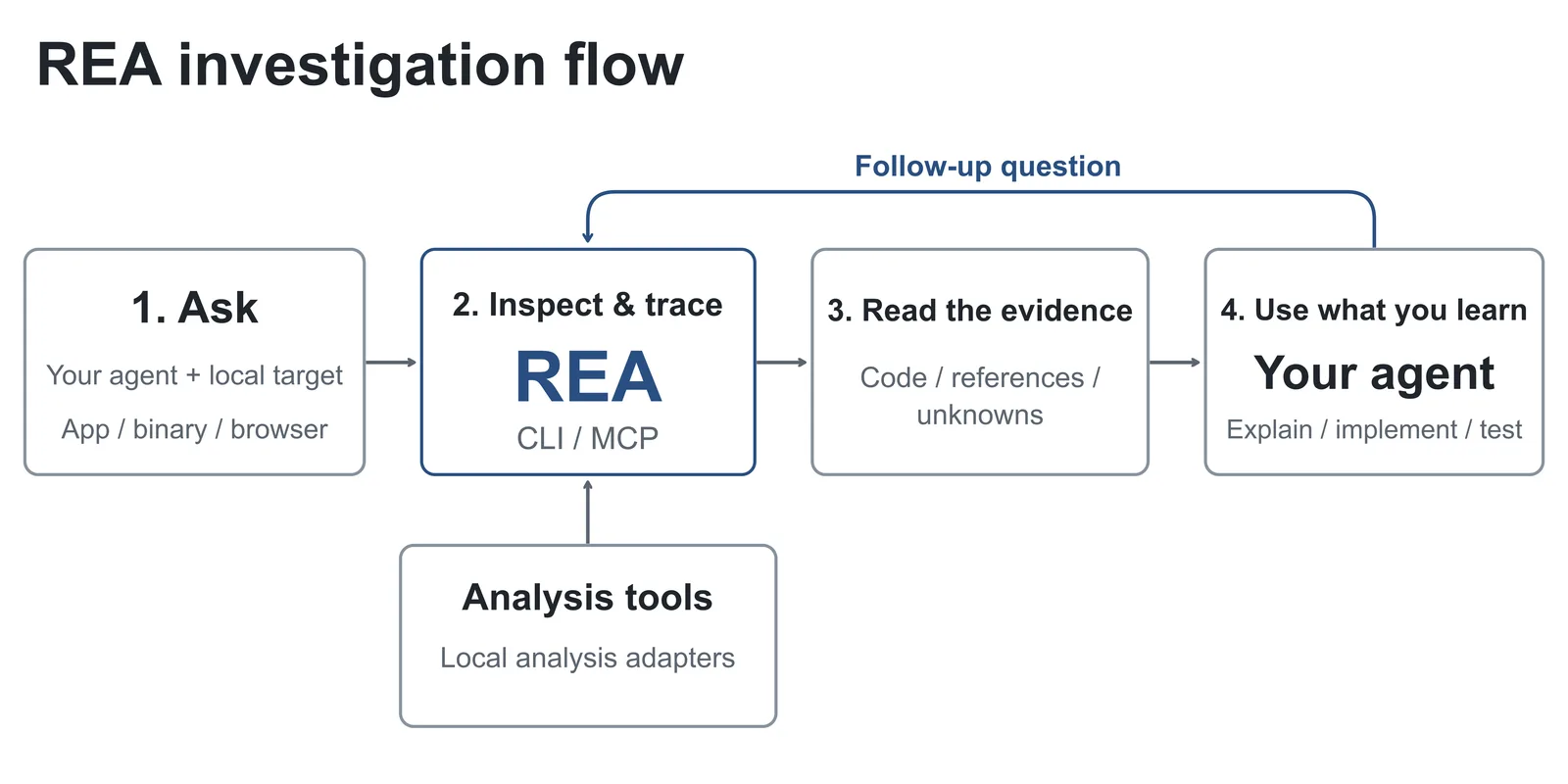
The flow has four steps: you ask the agent how something works, REA inspects and traces the target with local tools, the agent reads the returned evidence, and then uses what it learned to explain, implement, and test.
Who does what
The division of labor is the most important point for understanding the tool:
- REA collects evidence: code, references, and unknowns, meaning what has not yet been clarified.
- The AI agent interprets this evidence, explains the behavior, and writes its own implementation.
- You validate the result and decide what to do with it.
The fact that REA explicitly lists the unknowns is good practice: it reduces the risk of the agent inventing a plausible but wrong explanation.
The project's goal is for the agent to inspect the app without the source code, explain how a feature works, show the evidence, and build a version for your project.
How to install REA step by step
Installation is simple if you already use Node.js. Follow these steps:
- Check that you have Node.js 22 or newer installed.
- Run the rea-agents package setup command.
- Connect REA to the coding agent you already use (Claude Code, Cursor, Codex, etc.).
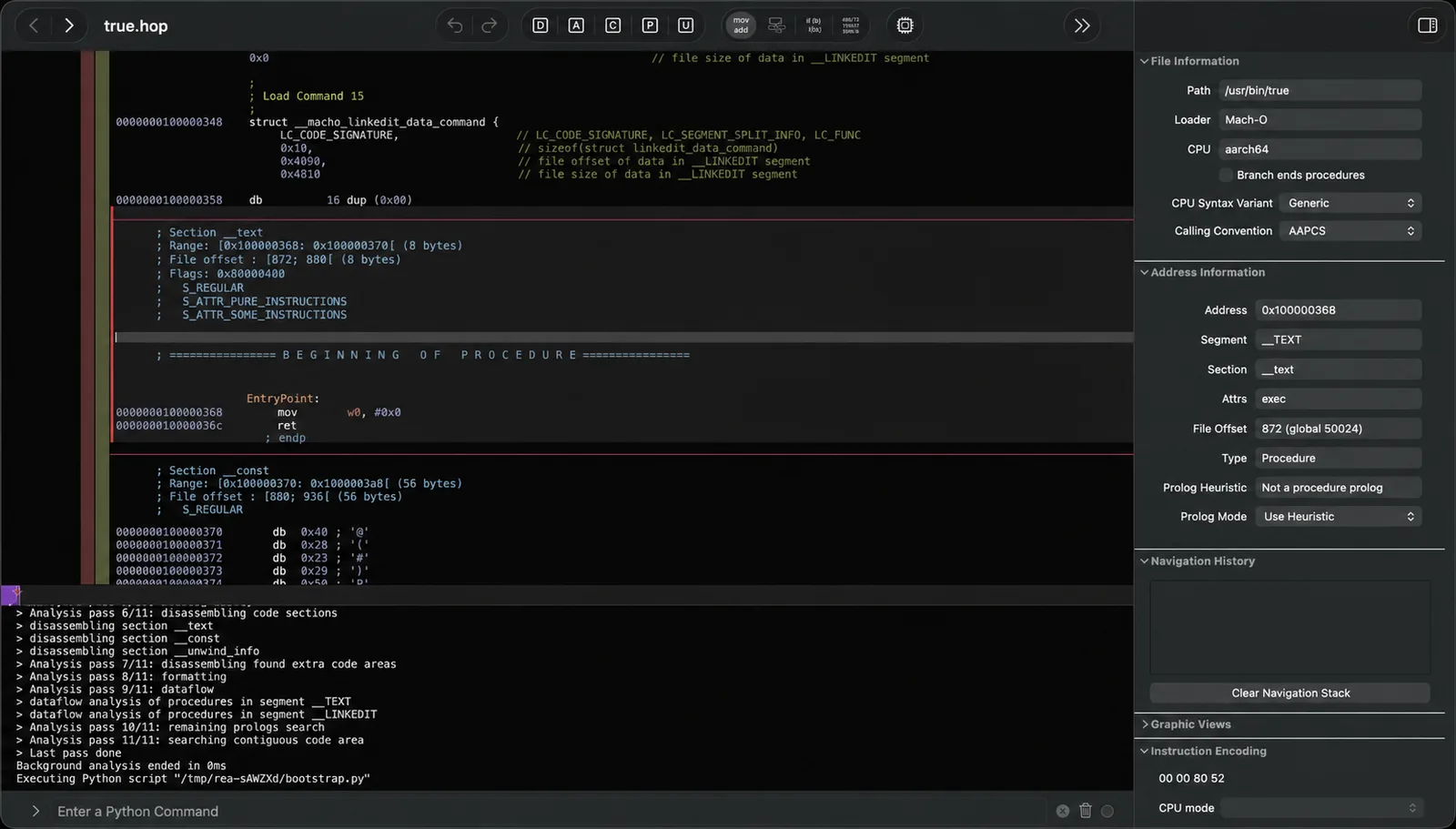
- To analyze native binaries, separately install one of the supported tools: Hopper, Ghidra, or IDA, which are disassembly and decompilation programs.
# verifique a versão do Node (precisa ser 22 ou superior)
node --version

# instale e configure o REA
npx rea-agents setup
The package is published on npm as rea-agents, so npx downloads and runs the latest version without a global install.
Watch the data that leaves your machine
The analysis runs locally, but the agent sends the results to the AI model provider, which has its own data policy. If you analyze an internal system with sensitive information, parts of it will end up on the provider's servers. Before using it on company software, read your provider's policy and assess the impact on confidentiality agreements and on LGPD (Brazil's data protection law).
What REA can analyze
The list of supported targets is broad:
- Native binaries, with Hopper, Ghidra or IDA installed separately.
- JavaScript and Electron apps, a common format for modern desktop applications.
- .NET assemblies, used in many corporate Windows systems.
- Android APKs, the installation package for the system's apps.
- Websites.
- Firmware, the software embedded in devices.
To show what is possible, the project publishes use cases in the official REA showcase. The three highlights are: the sound calculation from the game DX-Ball rebuilt in C, passing 3,205 cases compared against the original x86; the Notion clipboard; and a calculation from the PC-98 game TH04.
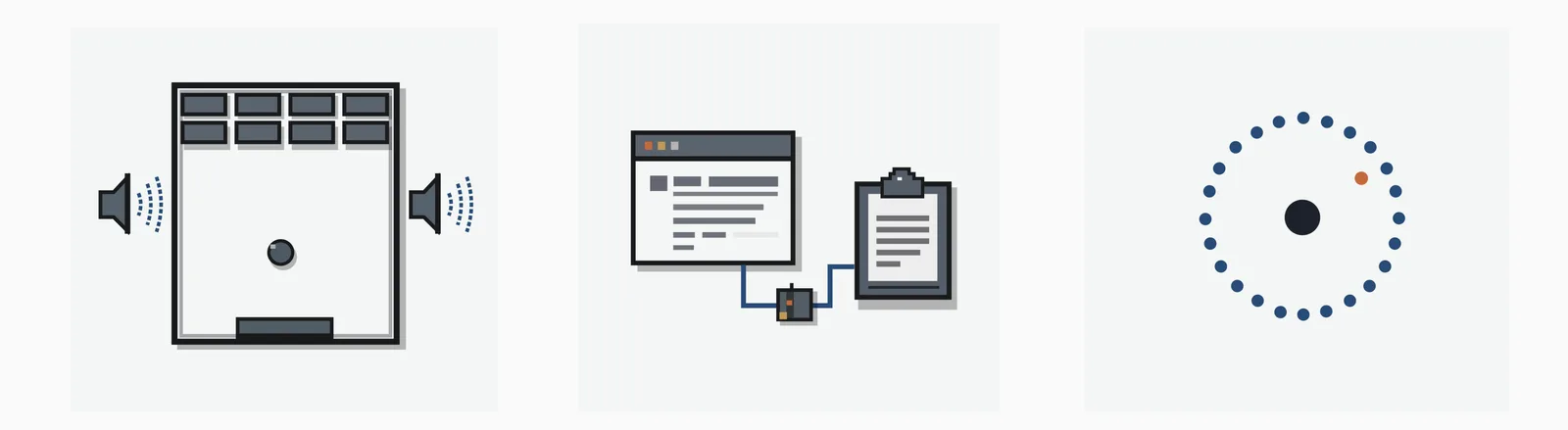
The DX-Ball case illustrates the method well: it is not enough for the agent to write similar-looking code. The new C version was tested against the original program's behavior in thousands of situations, and that is what gives confidence that the logic was truly understood.
AI reverse engineering and Brazilian law
Before anything else, read the official REA DISCLAIMER. It prohibits circumventing DRM (copy protection systems), license checks and anticheat, copying proprietary software and reproducing protected code and assets. The intended use is research, security, education, interoperability, preservation and your own or authorized software.
In Brazil, the reference is Law 9,609/1998, the Software Law. Two articles matter here:
- Art. 6: does not consider an infringement the similarity between programs caused by functional characteristics, nor technically indispensable integration for one's own use.
- Art. 12: provides for detention of six months to two years or a fine for anyone who violates a program's copyright, and imprisonment of one to four years when the reproduction is for commercial purposes.
Understanding how a feature works and building your own from scratch is one path. Copying third-party code, assets or protection is another, and the law treats the two very differently.
| Use | REA DISCLAIMER position | Legal point of attention |
|---|---|---|
| Analyzing your own company's software | Allowed (own software) | No authorship conflict |
| Integrating systems for your own use | Allowed (interoperability) | Art. 6 permits indispensable integration |
| Creating a feature with similar function | Allowed if no code is copied | Art. 6 permits functional similarity |
| Research, education and preservation | Allowed | Evaluate case by case |
| Circumventing DRM, licensing or anticheat | Prohibited | Risk of violating the rights holder's rights |
| Copying protected code or assets | Prohibited | Art. 12: detention or imprisonment |
This content is informational and does not replace legal advice. If your project involves a commercial product based on third-party software, talk to a lawyer specializing in intellectual property.
The ArtCraft case and the clean room
REA appeared in the Reel about ArtCraft, which brings together 12 programs cloned using the clean room technique: one team describes the original software's behavior and another writes the new code without access to the source code. We covered the project in our post about ArtCraft's free Photoshop clone.
However, nothing public links ArtCraft to REA. The association was made in the video, not by the projects. The methodological lesson still stands: documenting behavior and reimplementing is very different from copying.
Practical uses in your business
With the limits clear, there are plenty of legitimate and valuable applications:
- Understand a feature before building your own. If a competitor has an export feature your customers love, the agent can explain the logic and you implement your own version, without copying code.
- Audit your company's software. Security teams can examine what an internal app or a vendor-delivered binary actually does, within what the contract allows.
- Recover the logic of an old system without source code. That legacy .NET system whose vendor disappeared can have its calculation rules rebuilt and tested, as in the DX-Ball case.
A quick checklist before you start: confirm you have the right to analyze the target, check the software's contract or license, assess what data goes to the AI provider and document the process, separating what was observed from what was implemented.
Frequently asked questions
Is REA free?
Yes, REA's code is open source and published under the MIT license. What may cost money is the AI agent connected to it, which follows the plan of the provider you already use, and tools like IDA or Hopper, installed separately.
Is reverse engineering a crime in Brazil?
Not necessarily: Law 9.609/1998 does not consider similarity in functional characteristics or technically indispensable integration for personal use to be an offense. The crime lies in violating the program's copyright, with a harsher penalty when the reproduction is for commercial purposes.
Does REA work without the app's source code?
Yes, that is the core idea of the project. It inspects the compiled or published app and returns evidence so the agent can explain the behavior and build its own version.
Does the analyzed data stay only on my computer?
Not entirely. The analysis runs locally, but the agent sends the results to the AI model provider, which follows its own data policy. So be careful with systems that contain sensitive information.
Can I use REA to remove a program's license?
No. The project's DISCLAIMER prohibits bypassing DRM, license checks, and anticheat, and this kind of use may constitute copyright infringement under the Software Law.
Conclusion
REA has made AI-powered reverse engineering accessible to any developer with Node.js and a coding agent. It doesn't copy software: it collects evidence for the AI to explain and reimplement. The limit lies in its own DISCLAIMER and in Law 9.609/1998: understanding and integrating for personal use is one thing; copying code or bypassing protections is another.
Recommendation for today: pick a legacy system from your own company, with no sensitive data, and use REA to document a business rule that nobody can explain anymore. It's the safest way to test the tool and walk away with something useful.

About Lee Sugano
Lee Sugano
Digital solutions agency based in Japan, serving clients in 10+ countries. We share insights on development, design and digital marketing for companies that don't settle for generic.
Enjoyed this content?
Receive exclusive insights about web development, design, and digital marketing straight to your inbox.
No spam. Unsubscribe anytime.