NBR 17225: What Your Website Needs to Be Accessible
Discover what NBR 17225 requires for your website to be accessible and how to implement the guidelines of the new Brazilian technical standard.
NBR 17225: The Definitive Guide to Accessible Websites in Brazil
Your website needs to be accessible to everyone, and since 2015, the Brazilian Inclusion Law (LBI) has mandated companies with headquarters or commercial representation in Brazil to ensure this. However, a lack of clarity on how to implement this accessibility has led to a concerning reality: less than 3% of Brazilian websites meet the requirements. Fortunately, starting March 2025, we have NBR 17225, the Brazilian technical standard that details exactly what is necessary. This post will translate this standard into practical, verifiable tasks for your website.
Key Points:
- NBR 17225 is the Brazilian technical standard for digital accessibility, published in March 2025.
- It is based on WCAG 2.2 criteria and establishes 146 guidelines to ensure websites are usable by everyone.
- The standard covers everything from keyboard navigation and color contrast to complex interactions like CAPTCHAs.
- Less than 3% of Brazilian websites currently meet accessibility standards.
- Implementing NBR 17225 is a legal obligation and a crucial step towards digital inclusion.
The Urgent Need for Digital Accessibility
Digital accessibility is not just a matter of legal compliance; it's about inclusion and equal opportunities. The Brazilian Inclusion Law (Law 13.146/2015), in its Article 63, clearly states: "Accessibility is mandatory on websites maintained by companies with headquarters or commercial representation in the country." This provision aims to ensure that people with disabilities have full access to online products, services, and information.
The reality, however, shows a significant gap. A survey by Movimento Web para Todos, in partnership with BigDataCorp, revealed that less than 3% of Brazilian websites meet accessibility standards. Simone Freire, founder of Movimento Web para Todos, emphasizes its importance: "Innovation means ensuring that all people have access to products and services, and without accessibility, this is not possible." NBR 17225 emerges as a beacon, offering a technical roadmap to achieve this goal.
What is NBR 17225?
Published on March 11, 2025, by the Brazilian Association of Technical Standards (ABNT), NBR 17225 is the first edition of the Brazilian technical standard focused on digital accessibility. The development of the standard took about two years and involved 178 specialists in the ABNT Accessibility Committee (ABNT/CB-040). The technical coordination was led by Reinaldo Ferraz, project manager at Ceweb.br of NIC.br. After a national consultation, the standard was finalized.
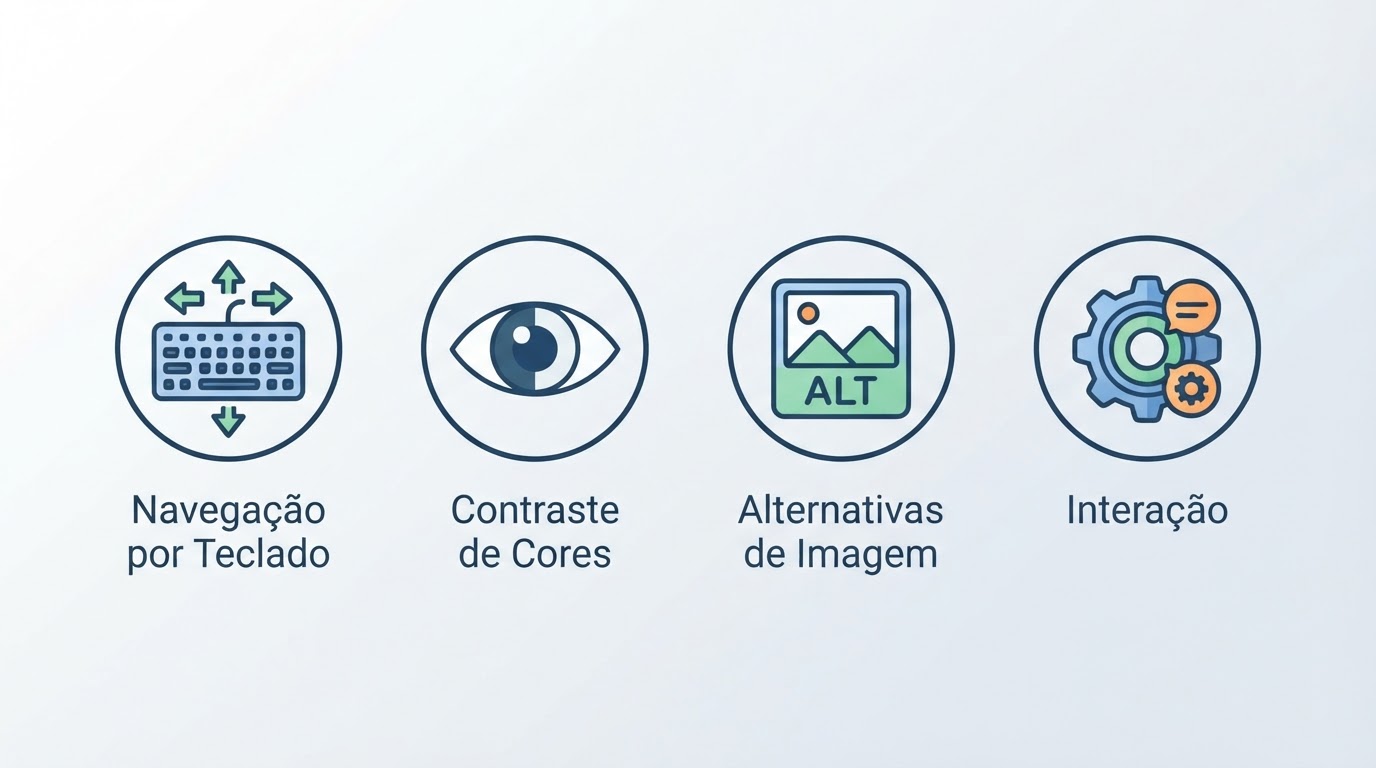
NBR 17225 compiles a total of 146 guidelines, including both mandatory requirements and recommendations. It aligns with the criteria established by the Web Content Accessibility Guidelines (WCAG) 2.2, an internationally recognized standard. The standard covers a wide range of essential elements for user experience, ensuring that online content is perceivable, understandable, navigable, and robust for everyone, regardless of their abilities.
Essential Guidelines of NBR 17225
The standard details multiple aspects of a website to ensure its accessibility. Let's explore some of the crucial points your website needs to consider:
1. Keyboard Interaction
All interactive elements, such as buttons, links, and forms, must be operable using only the keyboard. This is fundamental for users who cannot use a mouse. Navigation must be logical and intuitive, allowing the user to move easily between elements.
2. Image Content
Images that convey information must have textual alternatives (alt text). If an image is purely decorative, it should be marked to be ignored by assistive technologies. This allows screen readers to describe visual content to visually impaired users.
3. Structure and Headings
The correct use of headings (H1, H2, H3, etc.) is vital for organizing content and facilitating navigation. Proper use of headings helps screen reader users understand a page's structure and jump to sections of interest.
4. Links
Link texts should be descriptive, clearly indicating the destination or the action to be performed when clicked. Avoid generic texts like "click here."
5. Color Use and Contrast
Visual accessibility depends on adequate contrast between text and background. NBR 17225, following WCAG 2.2, stipulates a minimum contrast ratio of 4.5:1 for normal text and 7:1 for enhanced text. Furthermore, color should not be the sole means of conveying information; other visual or textual indicators must complement the message.
6. Fonts and Layout
The guidelines include specifications for spacing and readability. A line height of at least 1.5 times the font size, paragraph spacing of 2 times, letter spacing of 0.12, and word spacing of 0.16 are recommended. This improves readability for everyone, especially for individuals with learning disabilities or dyslexia.
7. Forms and Interactions
Forms must be clear, with labels associated with each field. Error messages should be specific and easy to identify. Critical items like CAPTCHAs and facial recognition must offer accessible alternatives or mechanisms that do not create insurmountable barriers.
8. Touch Targets and Animations
For touch-screen devices, touch targets (buttons, links) must have a minimum size of 24 by 24 CSS pixels. Animations must be controllable: they cannot start automatically or last more than 5 seconds in parallel with other content, allowing the user to pause, stop, or hide them.
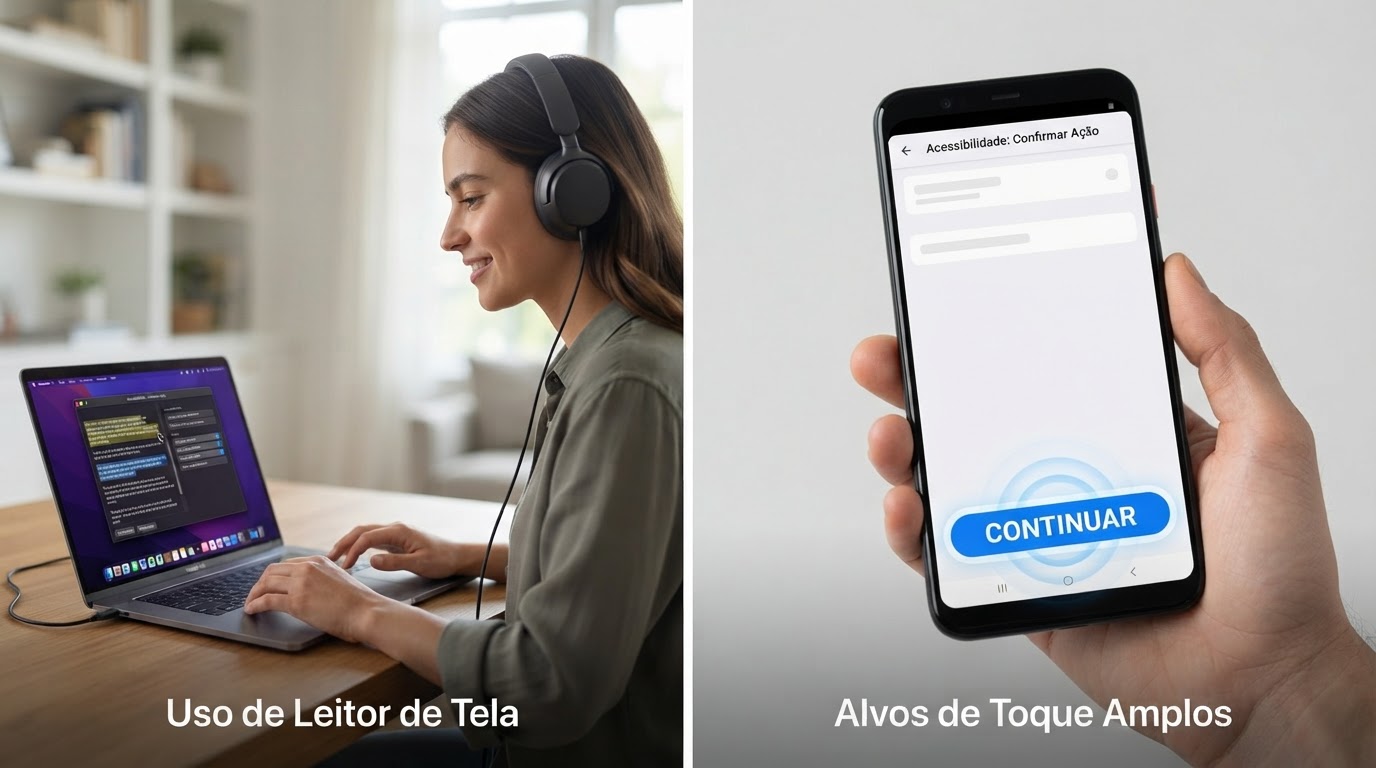
NBR 17225 is not just a set of technical rules, but a commitment to the inclusion and experience of all users.
How to Evaluate Your Website's Accessibility
NBR 17225 includes a checklist to assist in evaluating a website's accessibility level. In practice, an audit can follow a testing flow that combines automated tools and manual checks:
- Automated Tools: Start with tools like Lighthouse (integrated into Chrome DevTools) or WAVE (Web Accessibility Evaluation Tool). They quickly identify many common issues.
- Keyboard Navigation: Test navigation on all critical pages using only the
Tabkey (to advance) andShift+Tab(to go back). Ensure all interactive elements are reachable and that the focus is visible. - Screen Readers: Use screen readers like NVDA (free, for Windows) or VoiceOver (integrated into macOS and iOS) to simulate the experience of a visually impaired user. Navigate through the most important pages and interact with the elements.
- Contrast Analysis: Check color contrast with specific tools to ensure the 4.5:1 or 7:1 requirements are met.
- Content Review: Evaluate if the content is clear, if images have adequate
alt text, and if the heading structure is correct.
What to Do If Your Website Is Not Compliant?
If the audit reveals that your website does not meet NBR 17225 requirements, the first step is to prioritize corrections. A good starting point is to focus on the most critical requirements and those that directly impact navigation and access to main information.
For those using platforms like WordPress, there are plugins and themes that already offer accessibility features. However, customization and attention to specific details are still crucial. For front-end developers, it is essential to integrate accessibility practices from the beginning of the development cycle. If you use WordPress or Next.js, check the accessibility capabilities of each.

Implementation may require adjustments in CSS, HTML, and JavaScript. For example, ensuring that interactive components have the correct ARIA (Accessible Rich Internet Applications) attributes, that keyboard focus is managed properly, and that color contrasts are sufficient.
Frequently Asked Questions
Is NBR 17225 mandatory for all websites?
The legal obligation, established by the Brazilian Inclusion Law, applies to companies with headquarters or commercial representation in Brazil. NBR 17225 is the technical standard that specifies the requirements to comply with this obligation. Therefore, if your company falls under the LBI, adapting your website to NBR 17225 is essential.
What is the difference between NBR 17225 and WCAG 2.2?
NBR 17225 is the Brazilian technical standard that was built upon the criteria of WCAG 2.2, which is an international standard. The Brazilian standard translates and adapts the principles of WCAG to the context and legislation of Brazil, providing a more practical and specific guide for the national market.
How long does it take to make a website compliant with NBR 17225?
The time varies greatly depending on the website's complexity, its current structure, and the available team. Smaller, simpler websites may take weeks, while large portals or e-commerces with many interactive features might require months of work. It is an ongoing process that should be integrated into development.
Does an accessible website guarantee more traffic?
Directly, an accessible website may not generate more traffic, but it expands the audience that can access and interact with your content. Indirectly, the improved user experience and compliance with quality standards can positively impact SEO, in addition to avoiding legal penalties. An accessible website can also generate more qualified Lead Generation, as it removes access barriers for potential customers.
Conclusion
NBR 17225 represents a significant advancement for digital accessibility in Brazil, translating the legal obligation of the LBI into clear technical guidelines. Implementing these guidelines is not just about complying with the law, but about ensuring your business is inclusive and reaches a broader audience.
Start today by reviewing your website's color contrasts and keyboard navigation. These are simple steps that already make a big difference.

About Lee Sugano
Lee Sugano
Digital solutions agency based in Japan, serving clients in 10+ countries. We share insights on development, design and digital marketing for companies that don't settle for generic.
Enjoyed this content?
Receive exclusive insights about web development, design, and digital marketing straight to your inbox.
No spam. Unsubscribe anytime.