Claude Sonnet 5: Cheaper AI and Focused on Autonomous Agents
Anthropic launches Claude Sonnet 5 with a focus on autonomous agents and a reduced price. Discover what this means for product development and automations.
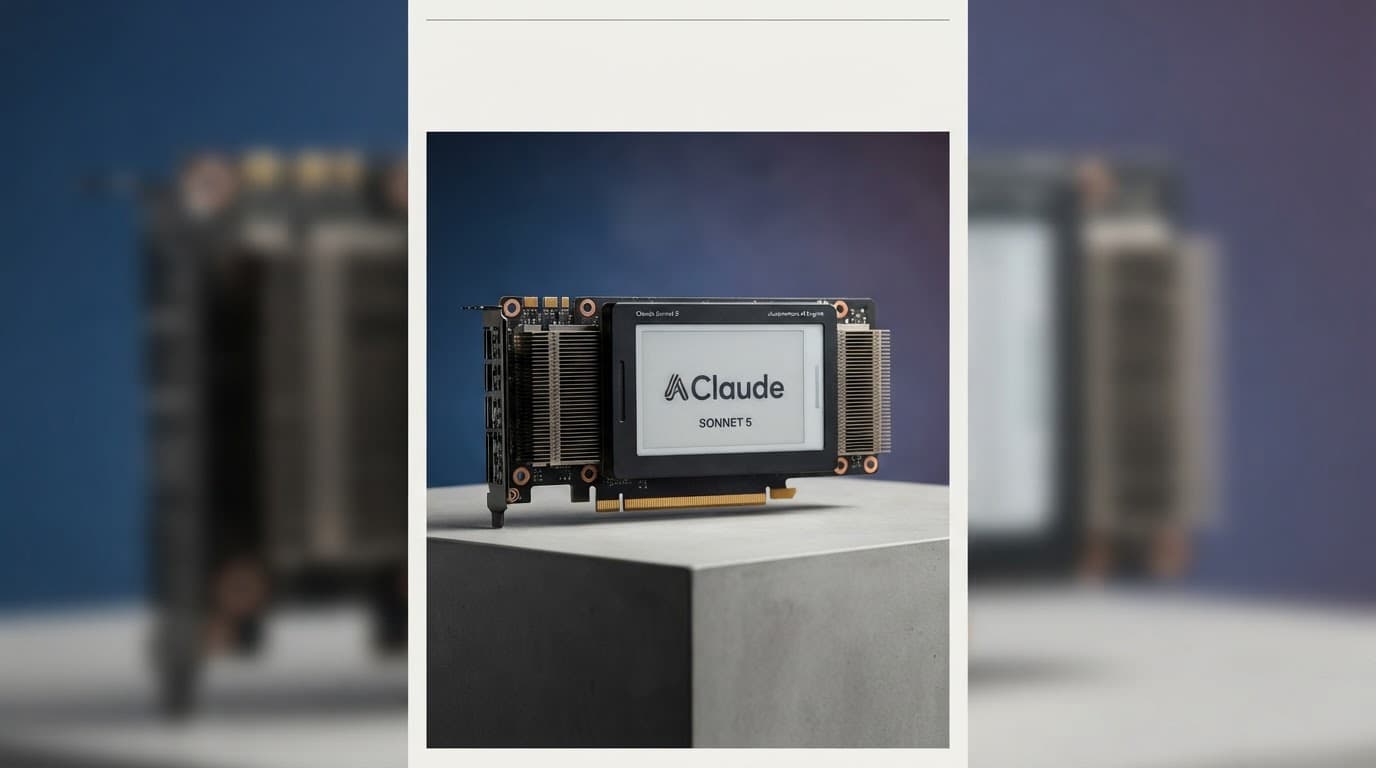
Claude Sonnet 5 Arrives Cheaper and Focused on Autonomous Agents
Anthropic announced the launch of Claude Sonnet 5, a new iteration of its large language model (LLM) that promises to revolutionize the way we develop and implement autonomous agents. With a clear focus on making them more capable and accessible, Sonnet 5 arrives with an attractive promotional price and a set of features that position it as a powerful option for developers and technology companies.
For those building AI-based products and automations, the news is especially relevant. The ability to execute complex workflows with AI agents more economically, without compromising performance, opens new doors for innovation. This post analyzes what Claude Sonnet 5 brings new, its practical implications for the market, and a critical look at its positioning.
Key points:
- Focus on Autonomous Agents: Sonnet 5 is Anthropic's most "agentic" model to date.
- Cost Reduction: Aggressive promotional pricing for input and output tokens, making automations cheaper.
- Advanced Capabilities: Enhanced planning, tool use (browsers, terminals), and autonomous execution.
- Competitive Performance: Approaches Opus 4.8 in benchmarks, with advantages in certain tasks and lower cost.
- Broad Availability: Accessible via Claude Code, API, Amazon Bedrock, Google Cloud Vertex AI, and Microsoft Foundry.
What Are Autonomous Agents in AI?
Before diving into Sonnet 5's new features, it's crucial to understand what an autonomous agent means in the context of artificial intelligence. Unlike a traditional chatbot that responds to direct commands, an autonomous agent is designed to perform complex tasks with little to no human intervention. It can receive an objective, break it down into smaller steps, use available tools (such as internet access, code execution, or software interactions), and learn from the process to achieve the desired outcome. Think of a personal assistant that not only answers questions but also schedules meetings, researches information, drafts emails, and even executes code to verify data, all independently.
Large language models like Claude Sonnet 5 are the brain behind these agents, allowing them to understand instructions, plan actions, and interact with the digital environment.
Claude Sonnet 5: A Leap in Capability and Accessibility
Anthropic launched Claude Sonnet 5 on June 30, 2026, positioning it as the most "agentic" version of its model to date. According to Anthropic itself, Sonnet 5 is capable of performing tasks that, until a few months ago, required larger and more expensive models. This includes the ability to create action plans, use external tools like web browsers and terminals, and operate autonomously with an impressive level of sophistication. According to Anthropic, this evolution "makes building AI applications that can reason, plan, and act more accessible and efficient."

This enhanced reasoning and autonomous execution capability is a game-changer for product development. Companies will be able to create solutions that automate more complex business processes, from data analysis to project management, with greater reliability and lower operational costs. For startups and small and medium-sized enterprises (SMEs), this represents an opportunity to compete with more robust solutions, democratizing access to advanced AI technologies.
Practical Implications: Lower Price, Greater Potential
The big news for those building products and automations is the promotional price of Claude Sonnet 5, valid until August 31, 2026. During this period, the cost is 2 dollars per million input tokens and 10 dollars per million output tokens. After the promotion, the standard price will be 3 dollars per million input tokens and 15 dollars per million output tokens. Compared to previous models or top competitors, this cost reduction is significant.
The practical message for SMEs and product developers is clear: running complex workflows with AI agents has become considerably cheaper, without the need to resort to less capable or more limited models.
Sonnet 5 stands out in agentic coding benchmarks, achieving 63.2%. Although Opus 4.8 has a slightly higher score (69.2%), Sonnet 5 surpasses it in tasks requiring specific knowledge and, of course, at a much lower cost. Compared to its predecessor, Sonnet 4.6 (which scored 58.1% in the same benchmark), the performance gain is remarkable. This approximate performance to Opus 4.8, combined with the reduced price, makes it an ideal candidate for applications that need a balance between intelligence and economy.
Comparative Table (Estimated Cost per Million Tokens)
| Model | Input Cost (USD/Mi) | Output Cost (USD/Mi) | Main Focus |
|---|---|---|---|
| Claude Sonnet 5 (Promotional) | 2 | 10 | Autonomous Agents |
| Claude Sonnet 5 (Standard) | 3 | 15 | Autonomous Agents |
| Claude Opus 4.8 | (Estimated: 20-30) | (Estimated: 50-80) | Complex Tasks |
Accessibility and Integration
Claude Sonnet 5 has been chosen as the default model for Anthropic's free and Pro plans, reinforcing its accessible nature. Furthermore, its availability extends across various cloud platforms, including:
- Claude Code
- Claude API
- Amazon Bedrock
- Google Cloud Vertex AI
- Microsoft Foundry
This broad integration facilitates adoption by developers already using these ecosystems, allowing them to incorporate Sonnet 5 into their existing projects without major technical barriers. The flexibility offered by these partnerships with major cloud providers is indicative of Anthropic's strategy to make its models widely accessible and easy to integrate.
Security and Reliability
Anthropic also highlights that Sonnet 5 exhibits a lower rate of undesirable behaviors and fewer hallucinations (incorrect or fabricated responses) compared to its predecessor. For critical applications, where precision and security are paramount, this improvement is a decisive factor. Autonomous agents that need to interact with real systems or provide crucial information for business decisions greatly benefit from more reliable models.
The reduction of hallucinations and undesirable behaviors is a direct advancement in the reliability of AI systems, crucial for large-scale applications.
This emphasis on security and reliability not only improves the end-user experience but also reduces the risks associated with implementing AI in sensitive processes. For companies looking to automate critical tasks, the assurance of a safer and more accurate model is an important differentiator. This can be compared to advancements in browser security, as seen in Vercel Releases WebSockets in Functions (Public Beta), where security and performance go hand in hand to enable new functionalities.
Critical Reading: What Does the Lower Price Really Mean?
While Claude Sonnet 5 offers an attractive package of capability and cost, it's important to maintain a critical perspective. Its positioning as "the most agentic" and its proximity to Opus 4.8 in benchmarks are commendable, but Opus 4.8 still leads in overall performance, especially in highly complex tasks or those requiring deeper reasoning. The choice between Sonnet 5 and Opus 4.8 will therefore depend on the specific nature of the task and the available budget.
For SME and startup developers, Sonnet 5 represents an excellent entry point for creating sophisticated autonomous agents. The cost-benefit is undeniable, allowing for experimentation and the implementation of innovative solutions with lower financial risk. However, for mission-critical applications that demand maximum performance and precision, cutting-edge models like Opus 4.8 (or future iterations) may continue to be the preferred choice.
The trend of more capable models becoming more accessible is an observable movement in the AI market, as seen in releases from other major players. For example, OpenAI Launches GPT-5.6: Meet the Sol, Terra, and Luna Models suggests a similar strategy of diversifying models for different needs. Similarly, initiatives like Google Genie 3: The AI that Creates 3D Worlds with Text Commands show a continuous effort to make AI more versatile and accessible.
Frequently Asked Questions
Is Claude Sonnet 5 better than Opus 4.8?
Claude Sonnet 5 is optimized for autonomous agent tasks and offers excellent cost-effectiveness, approaching Opus 4.8's performance in specific benchmarks. However, Opus 4.8 still tends to be superior in more complex general tasks or those requiring higher-level reasoning. The ideal choice will depend on the specific application and budget.
What is the main difference between Sonnet 5 and Sonnet 4.6?
Claude Sonnet 5 represents a significant advancement in capability, especially for autonomous agent tasks. It demonstrates superior performance in agentic coding benchmarks and is capable of executing plans and using tools more effectively than its predecessor, Sonnet 4.6, which scored lower in the same test.
How much does it cost to use Claude Sonnet 5?
Claude Sonnet 5 is available at a promotional price of 2 dollars per million input tokens and 10 dollars per million output tokens until August 31, 2026. After that date, the standard price will be 3 dollars per million input tokens and 15 dollars per million output tokens.
Where can I use Claude Sonnet 5?
Sonnet 5 is widely accessible through Claude Code, the Claude API, and cloud platforms like Amazon Bedrock, Google Cloud Vertex AI, and Microsoft Foundry. It is also the default model for Anthropic's free and Pro plans.
Conclusion
Claude Sonnet 5 marks a turning point in the AI market, offering a powerful model focused on autonomous agents at a more accessible price. For developers and companies looking to optimize automations and build new AI-based applications, this is a clear opportunity to innovate with lower costs. The combination of enhanced capabilities, security, and broad availability makes it a strategic choice for product development in the current technological landscape.
Recommendation: Start testing Sonnet 5 in one of your existing automation workflows or in a new pilot project. Explore its planning and tool-use capabilities to identify opportunities for optimization and cost reduction in your operations.

About Lee Sugano
Lee Sugano
Digital solutions agency based in Japan, serving clients in 10+ countries. We share insights on development, design and digital marketing for companies that don't settle for generic.
Enjoyed this content?
Receive exclusive insights about web development, design, and digital marketing straight to your inbox.
No spam. Unsubscribe anytime.