Automatic Pix on Your Website: What Really Changes in Your Checkout
Discover how Automatic Pix transforms recurring payments for e-commerces and SaaS, reducing costs and churn. Understand the checkout changes.
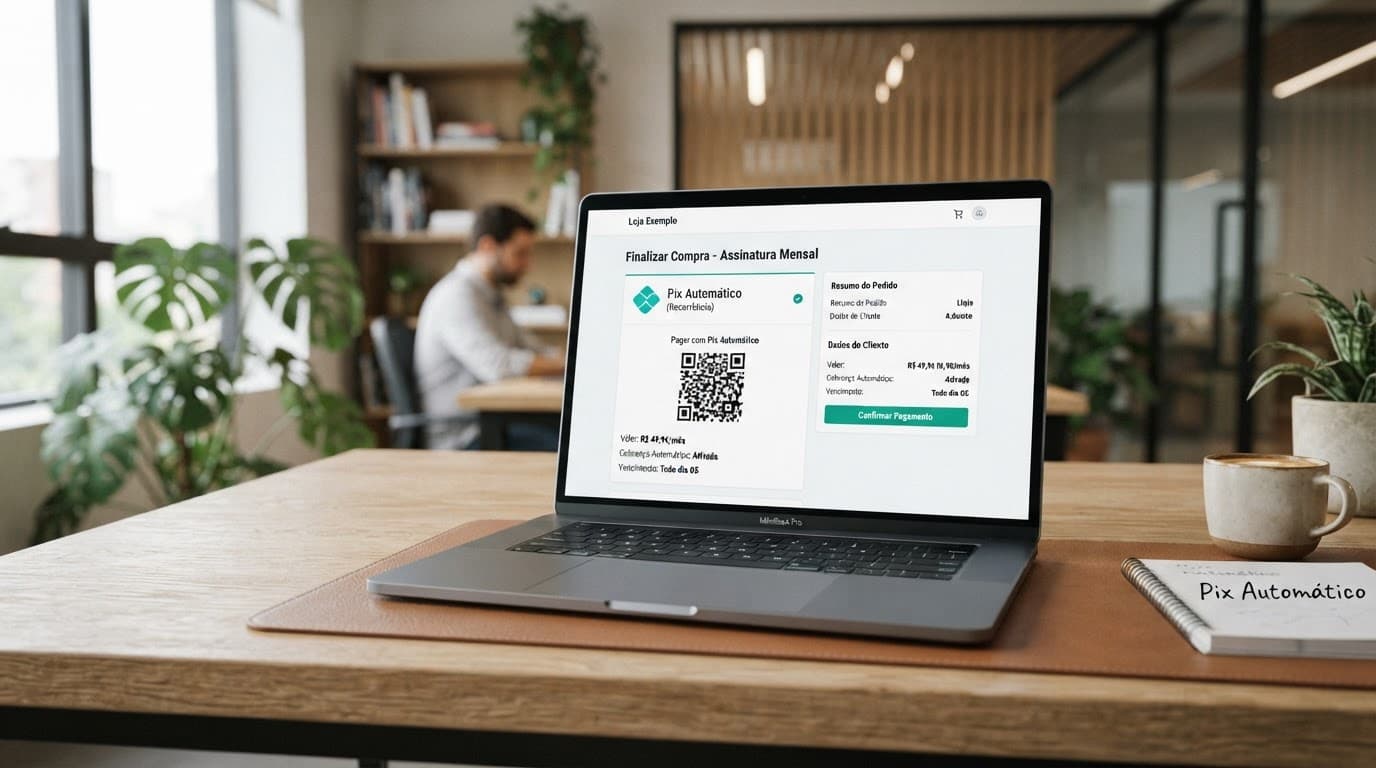
Automatic Pix on Your Website: What Really Changes in Your Checkout
Automatic Pix, announced by the Central Bank (BC), promises to revolutionize how companies charge for subscriptions and recurring services. Far from being just another payment method, it alters the checkout dynamic, especially for businesses that rely on monthly or periodic charges. If you manage an e-commerce, a SaaS, or any SME that charges recurring payments, understanding these changes is crucial for optimizing your operations and customer experience.
This comprehensive guide goes beyond the official announcement and explores the practical impact of Automatic Pix on your checkout, covering the authorization screen, value limits, payment retries, cancellations, and costs compared to credit cards. We will detail what truly changes for your business.
Key Points:
- Simplification of single authorization for recurring payments.
- Greater payer control with definition of maximum amount and rules.
- Significant reduction in operational costs compared to cards.
- Potential to decrease churn (cancellation rate) and attract new customers.
- New features like hybrid billing and salary accounts are planned.
How Automatic Pix Works in Checkout
Automatic Pix, officialized on June 4, 2025, with availability in banks starting June 16, 2025, according to BCB Resolution 402, was designed to simplify life for both consumers and service providers. The main novelty is the single authorization made by the payer, whether an individual or a legal entity, granting permission for recurring automatic debits.
This authorization can be done practically, often through scanning a QR Code containing the permission request data. The payer has the flexibility to set rules, including a maximum amount for transactions. This provides an extra layer of security and control, something that was lacking in some automatic debit models.
For the company charging recurring payments, the process becomes more efficient. Before each charge, the company sends the payment order to the payer's bank. The bank then schedules the debit and notifies the customer so they can review the details before the due date. This transparent communication is a differentiator.
Authorization Screen and Payer Control
The authorization screen is one of the central points of innovation. Unlike credit cards, where card information is saved and used for multiple transactions, Automatic Pix requires explicit and configurable consent. The payer scans a QR Code or accesses a link that directs them to their bank's app, where they review and approve the permission.
On this screen, important parameters can be set, such as the maximum amount that can be debited automatically. This feature is especially valuable for services whose values can fluctuate, like health plans or subscription packages with add-ons. The payer knows that, even with general authorization, there will be no surprises with exorbitant amounts, as the pre-established limit acts as a safety ceiling. The authorization, by default, is valid indefinitely but can be canceled at any time by the user in their bank app.
Optimizing Recurring Payments: Retries and Cancellation
One of the biggest challenges in recurring billing is dealing with payment failures, whether due to insufficient funds or other issues. Automatic Pix brings significant improvements in this aspect. If there are insufficient funds on the scheduled debit date, the system allows for new collection attempts. This increases the transaction success rate and reduces the need for manual intervention or customer contact for payment data updates.
Furthermore, cancellation management is simplified. The customer can cancel the debit authorization directly through their bank's app, quickly and easily. For the company, this means a more transparent exit process, which, paradoxically, can reduce friction and even impulsive churn decisions. An easy and documented cancellation can open doors for a future return.
Cost Comparison: Automatic Pix vs. Credit Card
For SME owners and e-commerces, the cost of payment processing fees is a decisive factor. In this regard, Automatic Pix presents itself as an extremely advantageous alternative when compared to credit cards.
While the MDR (Merchant Discount Rate) for recurring cards generally ranges between 2% and 3.5% per transaction, Automatic Pix has a significantly lower cost. PagBrasil estimates that Pix can cost up to 14 times less than cards. In a scenario with a high volume of recurring transactions, this saving can represent a substantial improvement in the business's profit margin.
A practical example comes from the client Fazenda Jotacê. Between July 2025 and May 2026, Automatic Pix accounted for 19% of their subscription transactions. Even more impressively, 82% of users who adopted this method were new customers, and the churn rate dropped by 25.2%. The cost, in this case, was 50% lower than that of cards.
Cost reduction and increased customer retention are the two pillars that make Automatic Pix a powerful tool for the sustainability of recurring businesses.
Integration and Implementation in Checkout
Implementing Automatic Pix in your checkout requires technological adaptations. For developers responsible for the checkout, integration generally involves using APIs provided by payment gateways or financial institutions. For example, in the Asaas API, a specific parameter, paymentCreationMode with the value SUBSCRIPTION, instructs the platform to generate recurring charges based on prior authorization.
The process can be initiated by generating a QR Code that the customer scans to authorize the debit. Once authorized, the company can manage future charges programmatically, ensuring that payments are processed on the correct dates and within the established rules. Activation is instant, a major advantage over the up to 45 days that traditional automatic debit can take.
Future of Automatic Pix: Salary Accounts and Hybrid Billing
The Central Bank continues to innovate and already has planned updates for Automatic Pix. Starting in October 2026, the inclusion of salary accounts is planned for this modality, which could further expand access to subscription services for a larger portion of the population. Additionally, hybrid billing will become a reality, combining boleto and Pix in the same QR Code. This allows, for example, a customer to choose to pay part of a bill via Pix and the rest via boleto, offering additional flexibility.
The BC president, Gabriel Galípolo, defined Pix as "money that travels at the speed of our time," highlighting the system's agility and modernity. The BC estimates that 60 million Brazilians without credit cards could gain easier access to service subscriptions with this new functionality.
Frequently Asked Questions about Automatic Pix
Is Automatic Pix free for the payer?
Yes, the Automatic Pix service is free for individual payers. Operational costs, if any, are absorbed by the receiving company, which benefits from reduced fees compared to other payment methods.
How does the customer cancel Automatic Pix?
Cancellation is done directly through the bank app where the customer made the authorization. Generally, there is a payment management or Pix section where the authorization can be revoked at any time, without needing to contact the company.
What happens if there are insufficient funds for the debit?
If funds are insufficient on the scheduled date, the system allows for new debit attempts. Retry rules may vary among financial institutions, but the goal is to maximize the chance of successful collection.
Does Automatic Pix replace credit cards for subscriptions?
It does not completely replace it, but it presents itself as a very strong alternative with clear advantages, especially in terms of cost and payer control. For recurring businesses, it could become the preferred payment method.
Conclusion
Automatic Pix represents a significant advancement for the Brazilian digital economy, especially for business models based on subscriptions and recurring payments. The simplification of authorization, additional payer control, drastic cost reduction, and potential churn decrease make it an indispensable tool for those seeking to optimize checkout and the business's financial health. Integration is straightforward, and future functionalities promise even more flexibility.
Recommendation: Start evaluating how to integrate Automatic Pix into your checkout right now. Consult your payment gateway or financial solutions provider to understand implementation options and prepare your business for this new era of recurring payments.

About Lee Sugano
Lee Sugano
Digital solutions agency based in Japan, serving clients in 10+ countries. We share insights on development, design and digital marketing for companies that don't settle for generic.
Enjoyed this content?
Receive exclusive insights about web development, design, and digital marketing straight to your inbox.
No spam. Unsubscribe anytime.