Next.js Launches Security Calendar: First Fixes Cover 9 Vulnerabilities
Vercel formalizes a monthly update program for Next.js, prioritizing security and planning for development teams.

Next.js Adopts Monthly Calendar for Security Fixes
Vercel, the company behind the popular JavaScript framework Next.js, has announced a significant change in how security updates will be handled: the introduction of a formalized calendar for security releases. The first release under this new program, on July 13, 2026, addressed nine vulnerabilities, marking a new era of predictability for developers using Next.js in production. Previously, fixes were published on an ad-hoc basis without prior notice, requiring immediate responses from teams and impacting deployment schedules.
This initiative aims to provide greater control and planning for development and operations teams. By anticipating release dates and the expected severity of vulnerabilities, Vercel allows teams to organize and apply updates smoothly. Furthermore, hosting providers can prepare in advance, implementing mitigations like firewall rules, even before the official patch release. This predictability is crucial in a landscape where cybersecurity is increasingly critical.
Key Points:
- Formalized Calendar: Next.js security updates now follow a monthly schedule.
- Preventing Disruptions: Increased predictability for teams to plan updates and mitigations.
- First Release: Nine vulnerabilities fixed (4 high-severity, 5 medium) on July 20, 2026.
- AI Context: Rise in vulnerabilities discovered by AI-assisted tools drives the initiative.
- Essential Planning: Need for an update plan for production teams.
The End of Ad-Hoc Fixes and the Beginning of Predictability
The previous practice of ad-hoc security releases for Next.js, while effective in responding to emergencies, created logistical challenges. Developers and DevOps teams often had to pause other tasks to address urgent updates, frequently without a defined timeline for application, which could lead to windows of vulnerability or rushed decisions. This new model, announced on the official Next.js blog by authors Andrew Imm and Josh Story, aims to resolve these difficulties.
The new security releases program foresees advance notices on the Next.js blog. Approximately once a month, Vercel will inform about the estimated date for the next release and the expected severity of vulnerabilities. This transparency is an important step towards adopting more robust security practices within the framework's ecosystem.
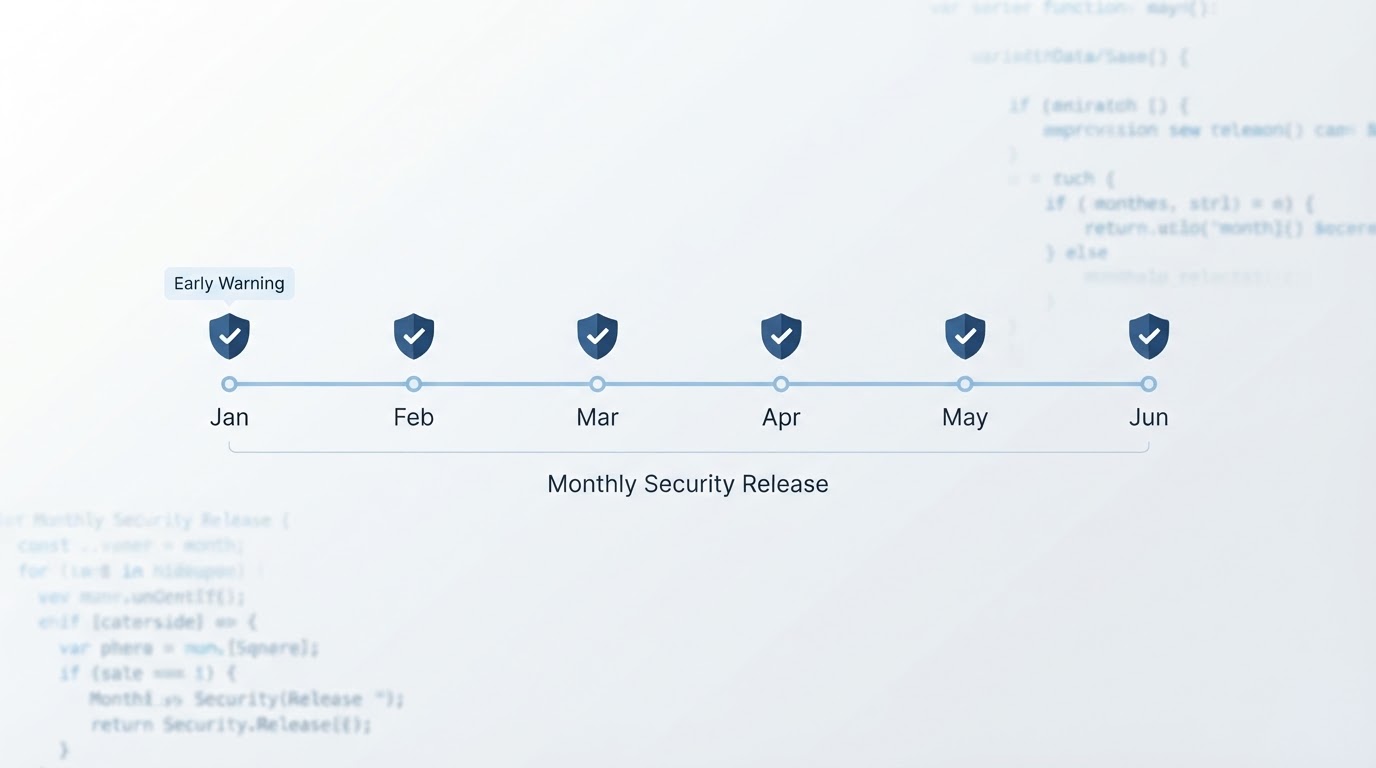
The First Update and What It Brought
The first scheduled release, with an anticipated date of July 20, 2026, has already demonstrated the initiative's relevance. The update focused on fixing nine security vulnerabilities: four classified as high-severity and five as medium-severity. The patches covered Next.js versions 16.2 and 15.5. CVE (Common Vulnerabilities and Exposures) identifiers, which are standard codes for describing security flaws, will be released along with the patches, providing more technical details for analysis and tracking.
The formalization of a security calendar is a recognition of Next.js's maturity and the need for more robust structures for large-scale software maintenance.
The Impact of Artificial Intelligence on Vulnerability Discovery
Vercel justifies the need for a more structured security program with the significant increase in vulnerability research, much of it assisted by Artificial Intelligence (AI). The text cites a recent example: Mozilla disclosed 271 issues in a single Firefox release, all found by Anthropic's Mythos Preview, an AI-based tool. This enhanced capability to find flaws demands a more agile and predictable fix cycle from framework developers.
To combat this new wave of threats, Vercel itself employs AI tools, such as those executed via deepsec, and has expanded its bug bounty program. Although the monthly calendar aims for most fixes, the company reiterates that ad-hoc patches will continue to be released for urgent cases or when already exploited vulnerabilities are discovered, as happened with the React2Shell exploit disclosed in December.
Why This Matters to You, a Next.js Developer?
If you or your team are responsible for production applications using Next.js, the adoption of this new security calendar has direct implications. The primary one is the need to establish an update plan. Instead of reacting to unexpected announcements, your team can now plan maintenance windows, test patches in staging environments, and ensure the transition occurs without significant disruption to end-users. This change transforms security management from a reactive task to a proactive and strategic activity.
Security updates are not just about fixing flaws; they are about ensuring the resilience, reliability, and integrity of your applications' data and functionalities. Ignoring these updates can expose your systems to attacks, leading to data loss, service interruption, reputational damage, and potential financial losses. Therefore, integrating the Next.js security calendar into your workflow is essential.
Frequently Asked Questions
What are Security Releases in Next.js?
Security Releases in Next.js are framework updates focused exclusively on fixing identified security vulnerabilities. Previously, they were released on an ad-hoc basis as vulnerabilities were discovered. Now, Vercel organizes them into a monthly schedule with advance notice, allowing for better planning.
Why did Vercel introduce a monthly calendar?
The introduction of a monthly calendar is due to the increase in vulnerability discovery, partly driven by AI tools, and the need to provide more predictability to development teams. This allows for more effective planning for applying fixes, minimizing disruptions in production environments.
Which Next.js versions will be covered by the updates?
The monthly security updates will cover actively supported versions of Next.js. In the first release, Next.js versions 16.2 and 15.5 were addressed. Vercel maintains a support cycle to ensure most applications receive the necessary fixes.
What should my team do now?
Your team should create or review your update plan for Next.js. Monitor the official Next.js blog for security release announcements. Plan testing and deployment windows that align with these dates, ensuring fixes are applied as soon as possible after release without compromising your application's stability.
Will there be updates outside the calendar?
Yes. While the monthly calendar brings predictability for most fixes, Vercel will maintain the ability to release ad-hoc patches for urgent vulnerabilities or those already being actively exploited, ensuring security in critical scenarios.
Conclusion
Vercel's formalization of the Next.js security calendar represents a significant advancement for the ecosystem's stability and security. The transition from point fixes to a predictable model will allow development teams to manage updates more strategically. For professionals running Next.js in production, the focus should now be on adapting processes to incorporate this new cycle, ensuring applications remain secure and reliable.
Recommendation: Start today by mapping your Next.js project's security dependencies and discuss with your team how to integrate the new security release calendar into your deployment workflow.

About Lee Sugano
Lee Sugano
Digital solutions agency based in Japan, serving clients in 10+ countries. We share insights on development, design and digital marketing for companies that don't settle for generic.
Enjoyed this content?
Receive exclusive insights about web development, design, and digital marketing straight to your inbox.
No spam. Unsubscribe anytime.