The Death List of Apps: Which Subscriptions AI Can Already Recreate (Can I Vibecode It)
The Can I Vibecode It death list: 30 apps well-known in Brazil, condemned, in the ICU, or surviving, what each verdict means, and what you lose before canceling a subscription.
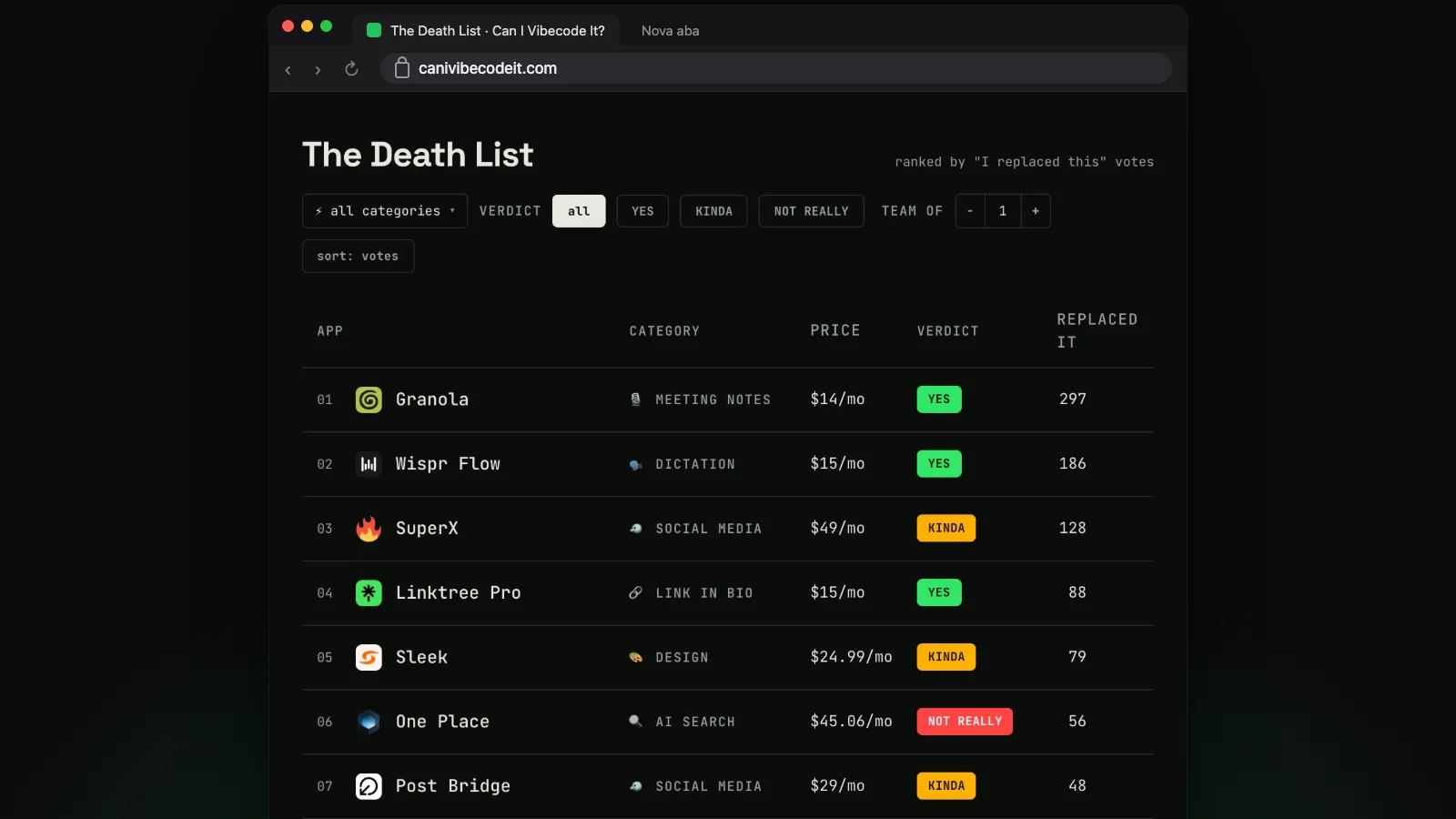
The English website Can I Vibecode It (canivibecodeit.com) has put together a "death list" (The Death List) of apps we pay for every month: 1,093 apps, from Canva to Netflix, each with a verdict. The question is always the same: can artificial intelligence already recreate this app, or is it still worth paying for the subscription? In the seven days leading up to 10/15/2026, Brazil was the country that visited the site the most, with 2,815 visitors, more than double the United States (1,192), according to the site's public dashboard.
Below is the list, with 30 apps well-known in Brazil. Afterwards, what each verdict means, why so many apps survive, and what to check before canceling a subscription. The numbers were verified on the website and in the public repository on 10/15/2026.
How to read the list: condemned (green) is the app that artificial intelligence can already recreate for personal use; in the ICU (yellow) can be recreated, but takes a weekend and leaves gaps; survives (red) is the app whose value is not in the code.
The death list: 30 apps well-known in Brazil
We've selected apps that appear frequently in the daily lives of those who work with the internet in Brazil. The price is from the website, in dollars per month. The "what you lose" column summarizes what the site lists for each: it's what disappears if you swap the subscription for a self-made app.
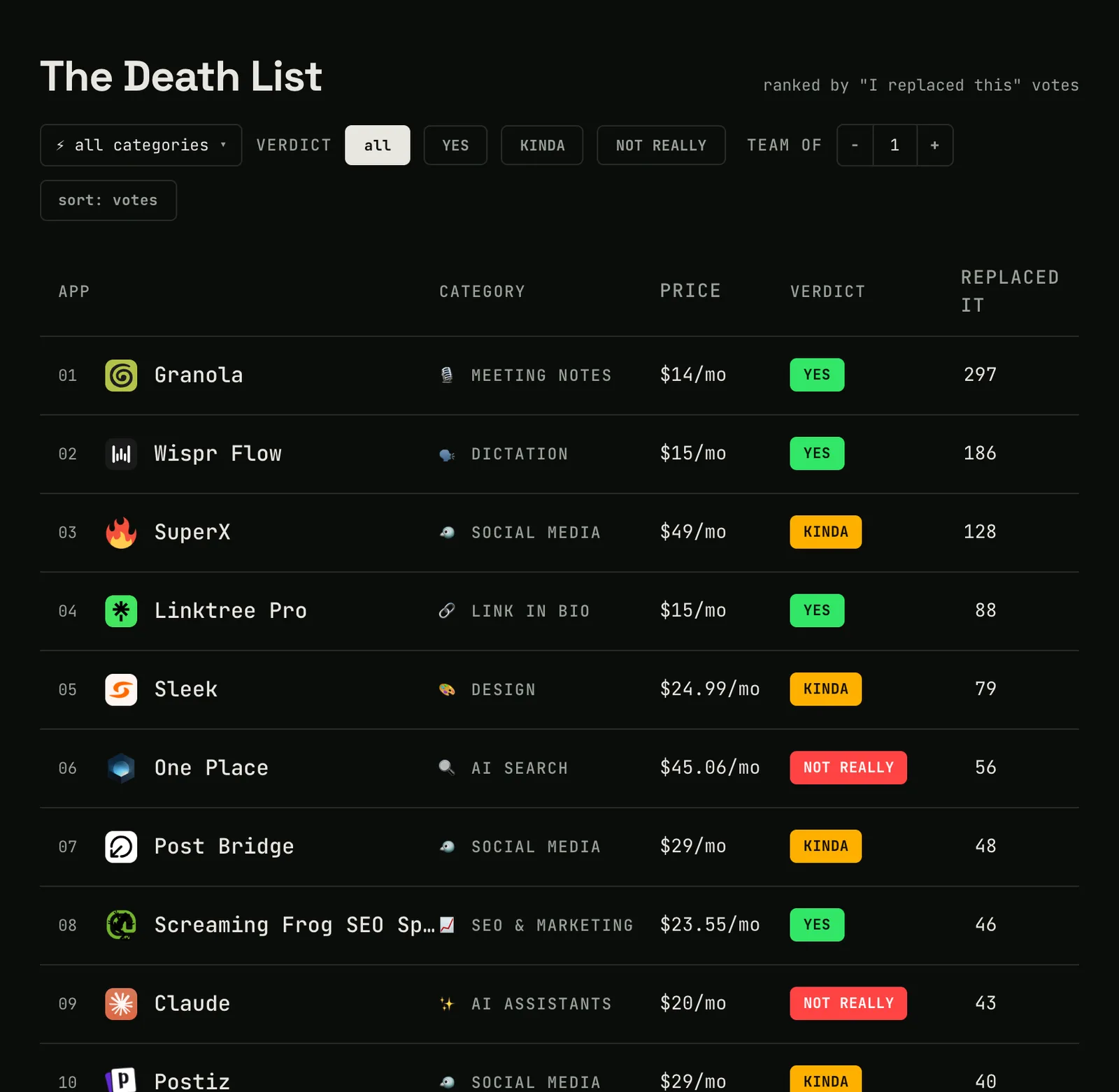
Condemned (green): AI already recreates a personal version
| App | Price | Time | What you lose |
|---|---|---|---|
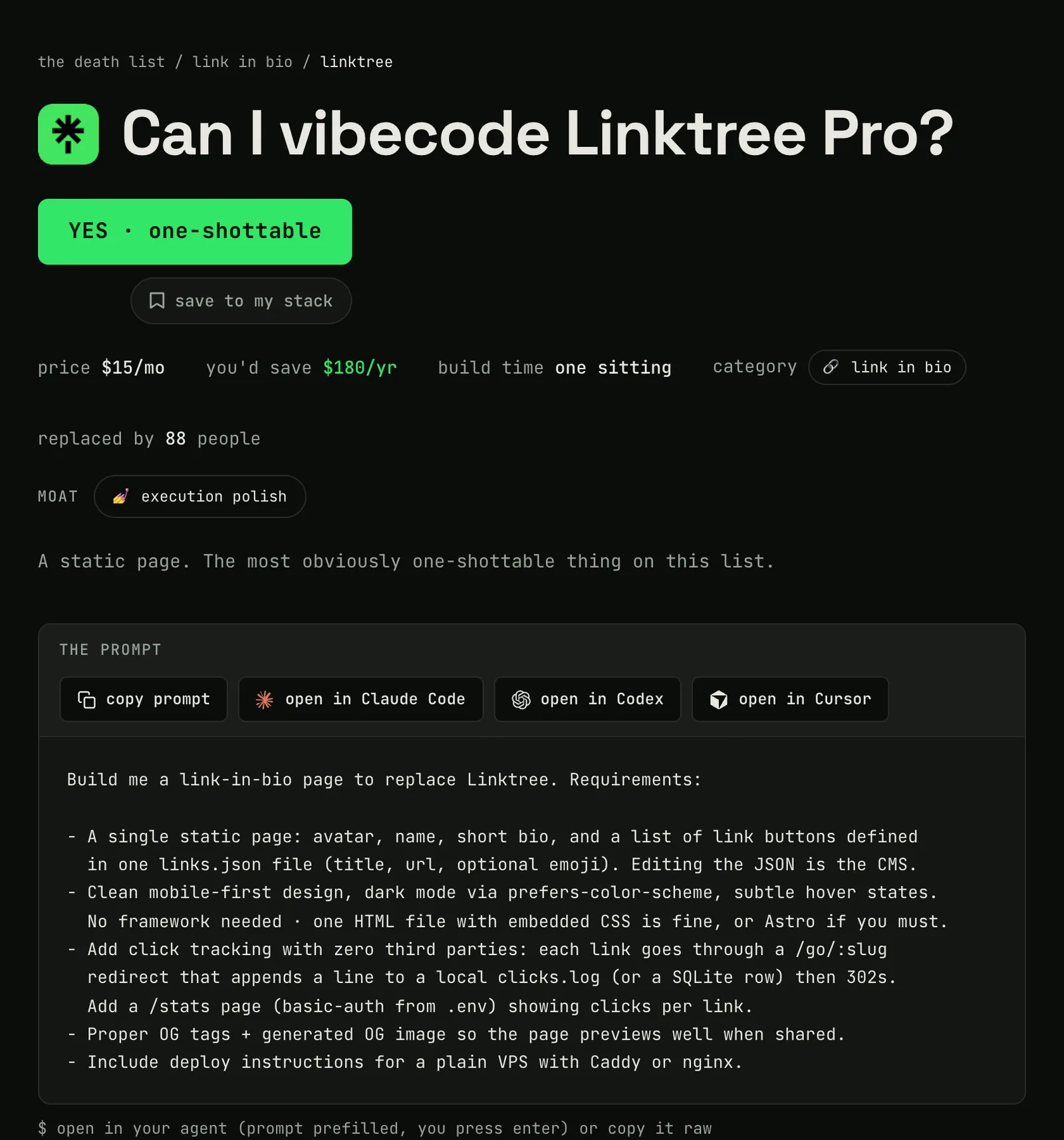
| Linktree Pro | US$ 15 | one session | drag editor, statistics dashboard, ready hosting |
| Bitly | US$ 35 | one session | links that survive your structure: if your domain expires, all links die |
| Todoist | US$ 7 | weekend | native apps, offline use, collaboration, reliable reminders |
| Tally | US$ 29 | weekend | beautiful editor, partial responses, custom domain, integrations, antispam |
| iLovePDF Premium | US$ 9 | several days | mobile app, OCR, batch files, legally valid signature |
In the ICU (yellow): can be recreated, but with gaps
| App | Price | Time | What you lose |
|---|---|---|---|
| Canva | US$ 15 | several days | template library, licensed images, brand kit, teamwork, mobile app |
| CapCut | US$ 19.99 | several days | mobile app, trendy effects and templates, library, rendering speed |
| Notion | US$ 12 | several days | block editor, synchronization, permissions, database views, integrations |
| Calendly | US$ 12 | weekend | Google and Outlook integration always working, team rotation, SMS reminder |
| Mailchimp | US$ 20 | several days | deliverability (email reaching inbox), automations, segmentation, compliance |
| Trello | US$ 12.50 | several days | Power-Ups, mobile app, automation, reliable notifications |
| Zapier | US$ 29.99 | weekend | integrations catalog, login maintenance, retries and history, availability |
| WordPress | US$ 4 | weekend | SEO plugins, form, cache and backup, WooCommerce |
| Wix | US$ 29 | weekend | drag editor, app store, online store and scheduling, hosting and domain, support |
| Typeform | US$ 39 | weekend | templates, respondent experience, analysis, payments, antispam |
| Gamma | US$ 9 | weekend | editor, export, statistics, custom domain |
| Loom | US$ 18 | weekend | instant hosting, permissions, comments, statistics |
| Pipedrive | US$ 14 | several days | email and calendar synchronization, automations, reports, mobile app |
| Grammarly | US$ 30 | several days | suggestions within any app, integrations, tone control |
Survives (red): value is not in the code
| App | Price | Time | What you lose |
|---|---|---|---|
| Shopify | US$ 25 | not alone | reliable checkout, fraud analysis, app store, shipping and taxes, support |
| ChatGPT | US$ 20 | not alone | cutting-edge models, image and voice, tools, reliability, updates |
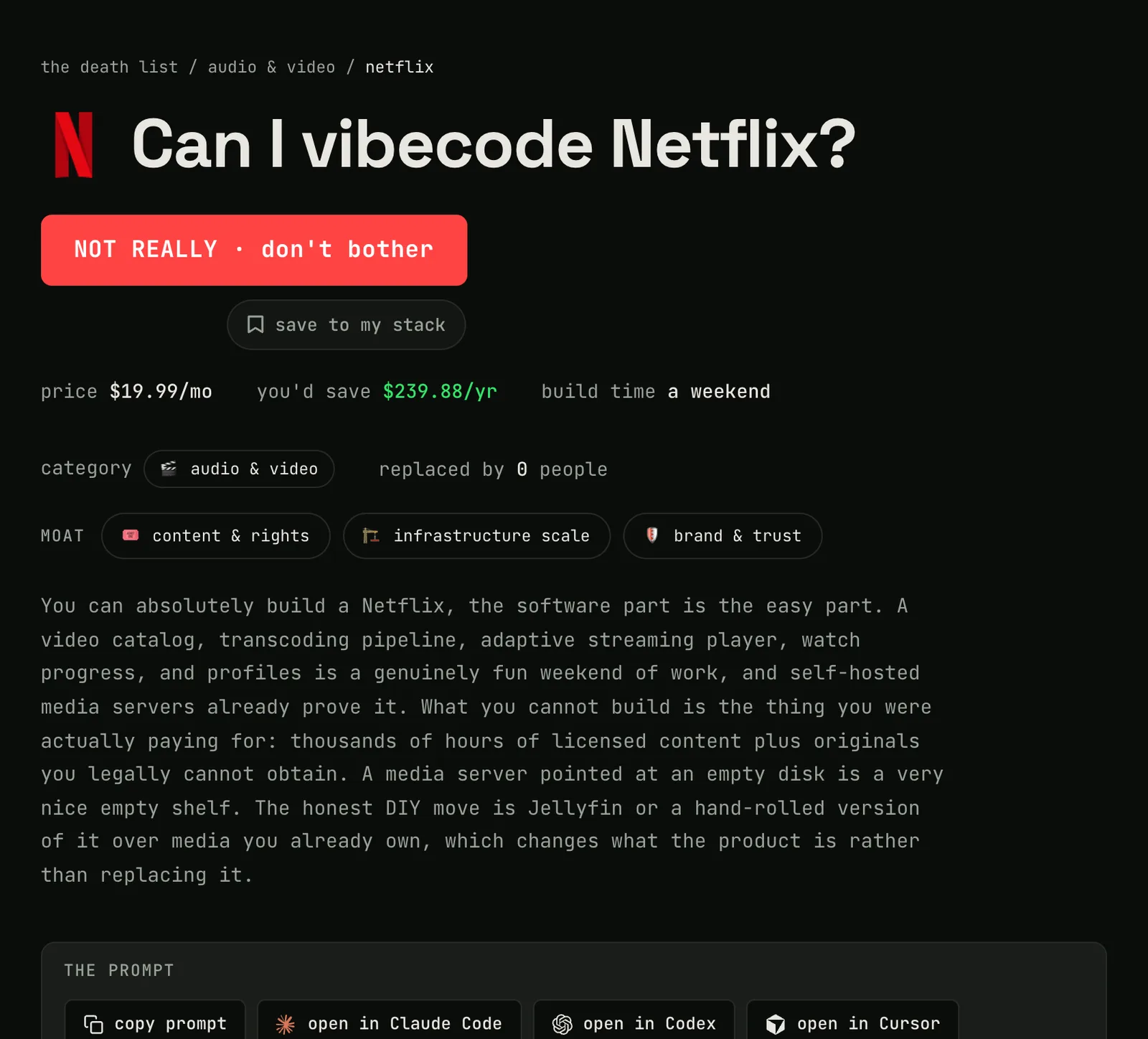
| Netflix | US$ 19.99 | the show, in a weekend | licensed catalog, seamless worldwide delivery, app on every TV |
| Spotify Premium | US$ 12.99 | only a consolation version | licensed catalog, artist rights and payments, recommendations |
| ManyChat | US$ 39 | the editor, in a weekend | Meta approval for messaging, visual editor, other channels |
| DocuSign | US$ 11 | only a consolation version | brand trust, identity verification, legal value, integrations |
| Figma | US$ 20 | not alone | real-time editing with the team, plugins, performance |
| Midjourney | US$ 10 | not alone | quality of proprietary model, consistent style, community |
| Duolingo Super | US$ 12.99 | only a consolation version | curriculum, adaptive models, student network |
| Microsoft 365 Personal | US$ 9.99 | only a consolation version | Office, OneDrive, synchronization, support |
| Google One | US$ 9.99 | only a consolation version | Google account integration, Photos, phone backup |
Condemned, in ICU, or Survives: What Each Verdict Means
Of the 1,093 apps on the list:
- Condemned (green, YES), 158 apps: a programming agent produces a version for personal use in a single session, running on your computer or server, without relying on another company (at most a simple API key). The site calls this "one-shottable": done in one request.
- In ICU (yellow, KINDA), 515 apps: can be built in a weekend, but real gaps remain, such as a mobile app, cross-device synchronization, login, and integrations with other services.
- Survives (red, NOT REALLY), 420 apps: the value lies in the network of people, data, infrastructure, or rules and laws. The site explains why the app survives and, when it makes sense, provides the prompt for a consolation version.
Three important warnings. "Condemned" is a way of saying the app is easy to recreate, not a prediction that the company will close. Green is for personal use, not for an entire company to switch systems. And the verdicts are editorial: none of the 158 green ones currently have the "one-shot verified" tag, which requires a public repository with proof. Only 23 of the green prompts have been manually reviewed; the others were generated from the app description and are open to correction.
What is Can I Vibecode It
"Vibe coding" is the name that stuck for programming by prompting: you describe the program you want in common language, and an artificial intelligence agent, like Claude Code, Codex, or Cursor, writes the code. Can I Vibecode It answers, app by app, whether this prompt is enough to replace a subscription.
The site has been live since 07/29/2026 and was created by the @robj3d3 profile. The data is open: each app is a file on GitHub, with an MIT license, and anyone can suggest a new app or dispute a verdict. As of 10/15/2026, there were 790 thousand page views, 129 thousand visitors, and 15,370 copied prompts.
What's on Each App's Page
- Price of the most common plan, in dollars, with the date it was checked and the source. In Brazil, the value may be different.
- Build time: one session, weekend, several days, or "not possible alone."
- The ready-made prompt, with buttons that open Claude Code, Codex, or Cursor with the text already filled in. You just press Enter.
- Why people still pay and what you lose by switching. Synchronization, mobile app, support, and other company's servers handling everything almost always appear.
- Free alternatives that already exist, for those who don't want to build anything. There are 2,373 free or open-source alternatives for 777 apps.
- The "I replaced this" counter, showing how many people claim to have replaced the app.
"Code is no longer a moat"
The most useful part of the site is not the list of condemned apps, but the explanation of why others survive. Each app receives one to three "moat" tags (what protects a business from competition). The phrase that opens this page summarizes the thesis: code has stopped being a moat.
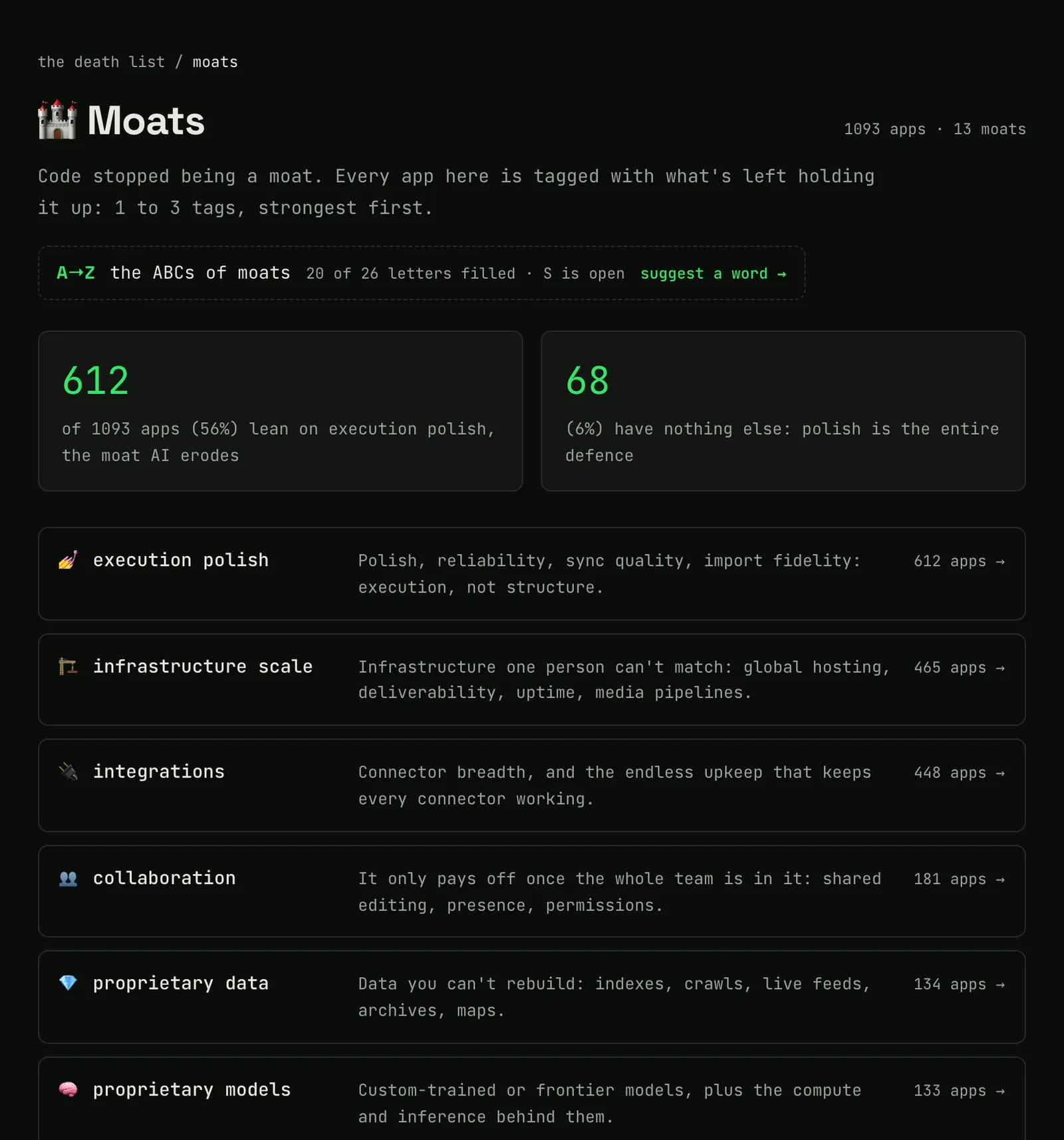
There are 13 tags. See how many apps rely on each one:
| Moat | What it is | Apps |
|---|---|---|
| Polish | refinement, reliability, sync quality: execution, not structure | 612 |
| Infrastructure at Scale | global hosting, email delivery, availability, media processing | 465 |
| Integrations | the number of connections to other services and the maintenance of each | 448 |
| Collaboration | only worthwhile when the entire team is in: co-editing, permissions | 181 |
| Proprietary Data | indexes, live data, files and maps that cannot be recreated | 134 |
| Proprietary Models | AI models trained by the company and the computing behind them | 133 |
| Rules and Laws | licenses, payroll, taxes, identity verification, legal risk | 122 |
| Content and Rights | licensed catalog, media rights, courses, template libraries | 112 |
| Brand and Trust | people pay because it's that company | 99 |
| Network Effect | gets better because other people are already there | 90 |
| Switching Cost | your history, settings, and habits make leaving difficult | 63 |
| Two-Sided Marketplace | two sides that need each other, and both are already there | 10 |
| Hardware | physical devices or data that only the company's device produces | 8 |
The most revealing data: 612 of 1,093 apps (56%) rely on polish, precisely the moat that AI most erodes. And 68 (6%) have no other: polish is their entire defense.
The Netflix example
About Netflix, the site is direct: you can build a Netflix, and the program is the easy part. Catalog, video conversion, player that adjusts quality, history, and profiles fit into a weekend's work. What doesn't fit is the licensed movie catalog, delivery that doesn't freeze on hotel Wi-Fi, and the app on every TV and video game console.
The ManyChat example
ManyChat, which responds to comments and messages on Instagram, is also in the red, and the reason is not technical. Keyword triggers, branching, and tags are, according to the site, a weekend of code. The difficult part is that every message goes through Meta, and it's Meta that decides who can send: the site cites reviewed apps, message permissions, and the 24-hour window rules. In its words, the bottleneck is access, not code.
Before canceling a subscription: 7 questions
- Can you take your data with you? Export everything before canceling and test if the new app opens the file.
- Where will the app run? On your computer, it only works when the computer is on. On a server, someone pays for and takes care of the hosting.
- Who will maintain it? Security updates, API changes, new browser. An app made on demand doesn't update itself.
- Does it contain customer personal data? If so, GDPR also applies to you: security, backup, and control of who accesses it.
- Does it require a mobile phone? Almost every green app becomes a web or desktop app. The mobile app is the one that disappears the most.
- How much do the APIs cost? Many custom solutions use AI or transcription keys that charge per use. Compare with the monthly fee.
- How much is your time worth? An afternoon of testing is cheap. A weekend a month fixing things is not.
And for businesses?
The list talks about subscriptions, but the question applies to any business that pays for software: do you pay for the program or for what comes with it? In a business system, what comes with it usually weighs more: hosting, security, backup, updates, and someone to call when something stops working.
And it applies to the other side too. If your business sells a digital service, it's worth looking at the list of moats and asking what, in your business, an AI prompt cannot copy: customer relationships, data that only you have, brand trust, customer service.
How to use the site, step-by-step
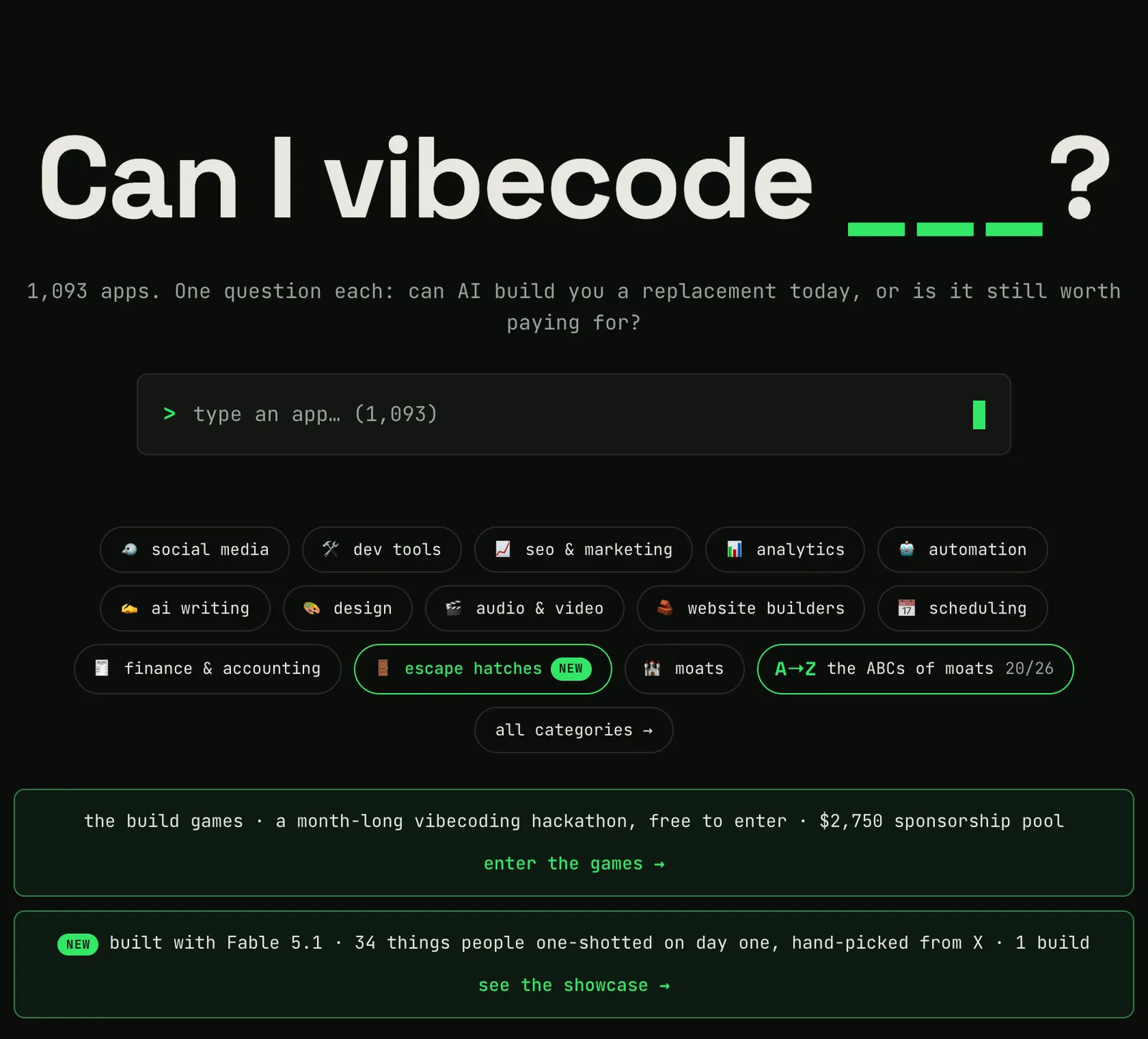
- Open canivibecodeit.com and type the app name in the search "Can I vibecode ___?".
- In "The Death List", filter by verdict (YES, KINDA, NOT REALLY) and by category.
- On the app's page, first read "what you lose". If anything on this list is essential for you, stop there.
- See the free alternatives: often there's already a ready-made open-source app, no need to build anything.
- If you're going to build, copy the prompt or use your agent's button (Claude Code, Codex, or Cursor). Test with dummy data before moving your own.
Frequently Asked Questions
Will the condemned apps disappear?
Not necessarily. The site does not predict the end of any company: it says whether artificial intelligence can already recreate a version for personal use. Many green apps continue to grow because they sell convenience, support, and a working service without you needing to manage it.
Is Can I Vibecode It free?
Yes. The list, verdicts, and requests are free, and the site's code is open source (MIT license). The site is maintained through sponsorship spaces and states that sponsorship does not buy verdicts.
Do I need to know how to program to use the requests?
For the green ones, little: the agent writes the code and explains how to install it. But you need to be able to install tools, create API keys, and decide where the app will run.
Does the site have a Portuguese version?
No, it is in English. The requests are also in English, and they work that way with programming agents.
Are the verdicts reliable?
They are a good first opinion, not a guarantee. They are editorial, discussed publicly on GitHub, and no "yes" has published proof yet.
Sources
- Can I Vibecode It, homepage and statistics dashboard, checked on 10/15/2026
- Moats page
- GitHub repository, with verdict criteria and data for each app
- Cited pages: Linktree, Canva, Shopify, Netflix, ManyChat

About Lee Sugano
Lee Sugano
Digital solutions agency based in Japan, serving clients in 10+ countries. We share insights on development, design and digital marketing for companies that don't settle for generic.
Enjoyed this content?
Receive exclusive insights about web development, design, and digital marketing straight to your inbox.
No spam. Unsubscribe anytime.