AI Agent Shopping: 7 Crucial Tweaks to Your E-commerce Catalog
AI agents are revolutionizing shopping. Discover the 7 essential tweaks to your e-commerce catalog to stay ahead and ensure visibility in future SERPs.

The New Era of Shopping: How to Prepare Your E-commerce for AI Agents
The future of online shopping has arrived, and it's autonomous. Artificial Intelligence (AI) agents, like virtual assistants, are becoming increasingly sophisticated, capable of performing complex tasks, including purchasing products on your behalf. In Brazil, this trend is even more pronounced: a Visa study revealed that 76% of Brazilians intend to use AI agents for shopping, demonstrating significantly higher confidence compared to the United States (44%). Security and transaction completion by AI also show impressive numbers in the country: 67% feel safe letting an agent complete a purchase, compared to 35% in the US. This revolution demands that e-commerces be prepared not only for customer interface but, fundamentally, for the machine that will act as an intermediary.
While the buzz around direct checkout on ChatGPT (a feature discontinued by OpenAI due to low adoption) might distract, the truth is that visibility and sales capability in an AI-driven landscape depend on a technical factor: a machine-readable product catalog. This means optimizing your e-commerce with structured data like GTIN (Global Trade Item Number), Product schema, real-time updated prices, and crucially, real-time stock. Ignoring these details means missing the opportunity to appear on what will be the new search result pages: SERPs (Search Engine Results Pages) dominated by AI agents. For e-commerce owners and developers, understanding and implementing these optimizations is no longer an option, but a strategic necessity.
Key Takeaways:
- Brazilian Adoption: 76% of Brazilians plan to use AI for shopping, surpassing the US.
- AI Trust: 67% of Brazilians trust AI agents to finalize purchases.
- Catalog is King: Your catalog's machine readability is what guarantees visibility for AI agents.
- Structured Data: GTIN,
Productschema, real-time price, and stock are essential. - Technical Standards: Understand UCP, ACP, and AP2 standards for agent communication.
The Brazilian Scenario: A Vanguard in Agentic Commerce
The Visa study Visa Agentic Commerce Consumer Study positions Brazil at the forefront of adoption and trust in AI agent shopping. The study highlights that 50% of Brazilians feel secure sharing financial data with AI platforms, a considerably higher rate than the 25% observed in the US. This trust is reflected in the willingness to let an AI agent complete the purchase (67% in Brazil vs. 35% in the US) and in the perception of security (50% vs. 25%). Additionally, 85% of Brazilians consider biometric authentication, such as passkeys, important for secure transactions, and 95% found the AI payment enablement process clear.
This leadership is not just perceptual. In March 2026, Banco do Brasil and Visa completed the first AI agent-initiated transaction in Brazil, using the Visa Intelligent Commerce platform. Shortly after, in April 2026, Visa launched the Visa Agent Ready program in the country, with strong participation from institutions like Banco do Brasil, Bradesco, Dock, Santander, and XP. Frederico Succi, VP of Products and Innovation at Visa Brazil, emphasizes that "trust, security, and control must be at the core of the solution," while Pedro Bramont, Director of Payments at BB, acknowledges that "the revolution challenges existing payment arrangements."
The Technical Standards Defining Interoperability
Communication between AI agents and e-commerce platforms is mediated by specific technical standards. Understanding these is vital to ensure your catalog is recognized and processed correctly. There are three main standards at play:
- UCP (Universal Commerce Protocol): Announced in January 2026 at NRF, this standard has the backing of giants like Google, Shopify, Etsy, Walmart, and Target. It operates under an Apache 2.0 license and is manifested in a
.well-known/ucpfile, supporting REST, A2A, and MCP. Shopify has offered self-serve support for UCP since June 2026. This standard focuses on interoperability and data standardization for a unified shopping experience. - ACP (Agentic Commerce Protocol): Developed by OpenAI in partnership with Stripe and announced in September 2025, ACP introduced Stripe's
Shared Payment Tokenconcept. ACP became the base infrastructure for developingChatGPT Apps, even after the commercial failure of Instant Checkout. - AP2: Announced in September 2025 and under FIDO Alliance governance since April 2026, AP2 uses W3C verifiable credentials, with specific mandates for
Intent,Cart, andPayment.
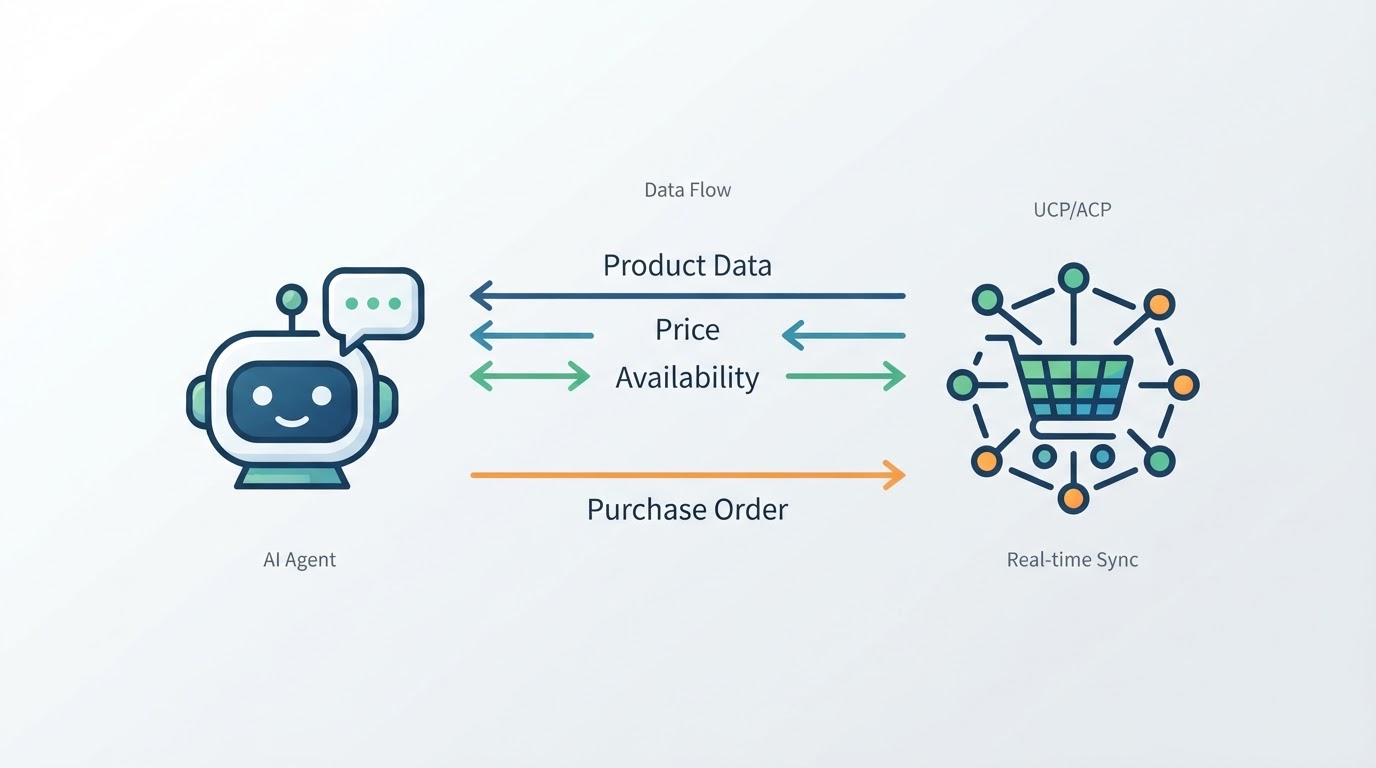
It's crucial to note that the hype around certain features, like direct checkout on ChatGPT, often obscures the technical fundamentals. OpenAI deactivated Instant Checkout after a few months with insignificant sales, proving that the foundation for success lies not in direct interface, but in catalog robustness and agent processing capability.
The 7 Essential Tweaks to Your Product Catalog
Visibility and sales capability for AI agents depend directly on the quality and structure of your catalog data. Forget generic content marketing tactics about agentic commerce; what determines if your store appears is a flawless technical catalog. Here are the 7 crucial tweaks:
1. Valid and Complete GTIN
GTIN (Global Trade Item Number), or EAN (European Article Number), is a unique identifier for physical products. AI agents and search platforms use it to identify and compare products accurately. A missing or invalid GTIN can cause your product to be ignored or miscategorized. Ensure each product has a correct GTIN associated with it.
2. Structured Product Data (Schema.org)
Structured data, using Schema.org's Product vocabulary, is the language search engines and AI agents understand. It provides detailed information about your products, such as name, description, brand, image, and crucially, price and availability. Correctly implementing the Product schema ensures agents capture the most important information about your item in an organized manner.
3. Real-Time Price and Currency (ISO 4217)
AI agents need exact, up-to-date price information for comparisons and negotiations. Use the ISO 4217 standard to specify the currency (e.g., BRL for Brazilian Real) and ensure the price displayed in your schema and feed is always synchronized with your store's current price. Undetected price variations can lead to errors and lost sales.
4. Real-Time Availability and Stock
Nothing frustrates a customer (or an efficiency-seeking AI agent) more than a product listed as available only to be out of stock at the time of purchase. Your inventory management system must be integrated with your product feed and structured data, updating availability in real-time. Stock information must be reliable and machine-accessible.
5. Catalog Treated as Infrastructure
This is a fundamental mindset shift. Your catalog is not just a virtual storefront but the infrastructure upon which AI agents will operate. This means data quality, organization, accuracy, and constant updates are technical priorities, not just marketing ones. Think of each catalog item as a critical data point.
6. Machine-Optimized Titles and Descriptions
While character limits may vary between standards (e.g., ACP accepts titles up to 150 characters and descriptions up to 5,000 characters), clarity and conciseness are essential. Use relevant keywords, but more importantly, ensure essential information is present and easily extractable by an agent. Long descriptions should be well-structured.
7. Daily (or More Frequent) Updates
AI agents and search systems crawl and process product information. Keeping a product feed updated daily, or even more frequently if possible, with all complete attributes ensures agents are always accessing the latest price, stock, and availability data. Formats like .jsonl.gz, .csv.gz, or .xml.gz are common for feeds.

The secret to agentic commerce isn't selling within ChatGPT, but having a catalog that AI agents can efficiently read and process.
Implementing Product Feeds in the ACP Standard
Product feeds in the ACP (Agentic Commerce Protocol) format are designed to be efficient and comprehensive. They generally accept compressed files to optimize data transfer. When preparing your feed, pay attention to the following points:
- File Format: Use compressed formats like
.jsonl.gz,.csv.gz, or.xml.gz. - Title: Keep titles clear and descriptive, with a limit of up to 150 characters.
- Description: Provide detailed descriptions that can reach up to 5,000 characters. Structure the text well to facilitate AI reading.
- Price: Include the price with the currency specified in the ISO 4217 standard. E.g.,
{"amount": 99.90, "currency": "BRL"}. - Availability: Clearly indicate if the product is in stock, out of stock, pre-order, etc.
- Images: Include URLs for high-quality images.
- Update Frequency: Daily feed updates are recommended to ensure data accuracy.
Frequently Asked Questions about AI Agents and E-commerce
How can my e-commerce appear in AI agent searches?
For your e-commerce to appear in AI agent searches, the most crucial factor is having an optimized product catalog. This involves correct implementation of structured data (schema.org/Product), inclusion of unique identifiers like GTIN, display of real-time prices and availability, and structuring data for machine readability. Technical standards like UCP and ACP define how this communication should occur.
What is the difference between Agentic Commerce and traditional shopping?
The main difference lies in the automation and intelligence of the intermediation. Instead of a human actively browsing a website to find and buy a product, an AI agent performs this task based on instructions (prompts) and predefined parameters. It searches, compares, selects, and often completes the purchase, requiring the e-commerce to expose its data clearly and structurally for this artificial intelligence.
What are structured data and why are they important for AI agents?
Structured data is information organized in a standardized format that facilitates interpretation by software, such as AI agents. schema.org/Product is a specific vocabulary for describing products, containing attributes like name, price, description, images, and stock. They are vital because they allow agents to understand your product's characteristics quickly and accurately, without ambiguity, optimizing search and comparison capabilities.
What is GTIN and why does my e-commerce need it?
GTIN (Global Trade Item Number) is a global unique identifier for products. It's like an ID for every marketable item. AI agents and search systems use GTIN to identify products unequivocally across different sellers and platforms. Having a valid GTIN correctly associated with your product in the catalog increases listing accuracy, improves discoverability, and prevents duplication or confusion with similar products.
How is security handled in AI agent transactions?
Security is a fundamental pillar. The Visa study points to the importance of biometric authentication (passkeys) and clear payment enablement processes. Standards like AP2, under FIDO Alliance governance, focus on using W3C verifiable credentials, while ACP uses Stripe's Shared Payment Tokens. For e-commerce, this means ensuring that the payment and authentication methods offered are compatible with these new protocols and that customer data is handled with the utmost rigor in compliance with LGPD.
Conclusion
Agentic commerce is not a distant promise but a rising reality in Brazil, driven by a confident consumer and an innovative financial ecosystem. Ignoring the technical preparation of your product catalog risks invisibility in the future of online shopping. Focus on data accuracy, structured data implementation, and constant updates. These are the foundations for your e-commerce to be found and chosen by AI agents.
Recommendation: Start today by reviewing your catalog. Check for the presence and validity of GTINs, implement schema.org/Product structured data, and ensure your price and stock information is accessible in real-time. These technical actions are your greatest assets for agentic commerce.

About Lee Sugano
Lee Sugano
Digital solutions agency based in Japan, serving clients in 10+ countries. We share insights on development, design and digital marketing for companies that don't settle for generic.
Enjoyed this content?
Receive exclusive insights about web development, design, and digital marketing straight to your inbox.
No spam. Unsubscribe anytime.